The Short Version:
-
- Not every home improvement is actually an improvement. Some upgrades shrink your buyer pool and drag down your resale value.
- Over-personalization, high-maintenance features, and garage conversions are common culprits. Buyers see the cost of undoing your decisions, not the value you added.
- Reducing your bedroom count is one of the most expensive mistakes homeowners make. That extra closet space might cost you $30,000 at resale.
- The best upgrades appeal to the widest audience. Everything else is personal preference… which is fine, as long as you’re not expecting to get that money back.
Not every home improvement is actually an improvement.
Some modifications that feel like upgrades while you’re living in the house become liabilities when it’s time to sell. If a change shrinks your potential buyer pool or creates extra work for the next owner, it can actually drag down your home’s value.
I’ve seen this play out countless times… homeowners who sink money into projects expecting a return, only to discover they’ve made their home harder to sell. The upgrades that hurt you are almost always the ones that feel great in the moment but don’t translate to broad market appeal.
Here are five common “upgrades” that often backfire.
1. Over-Personalization
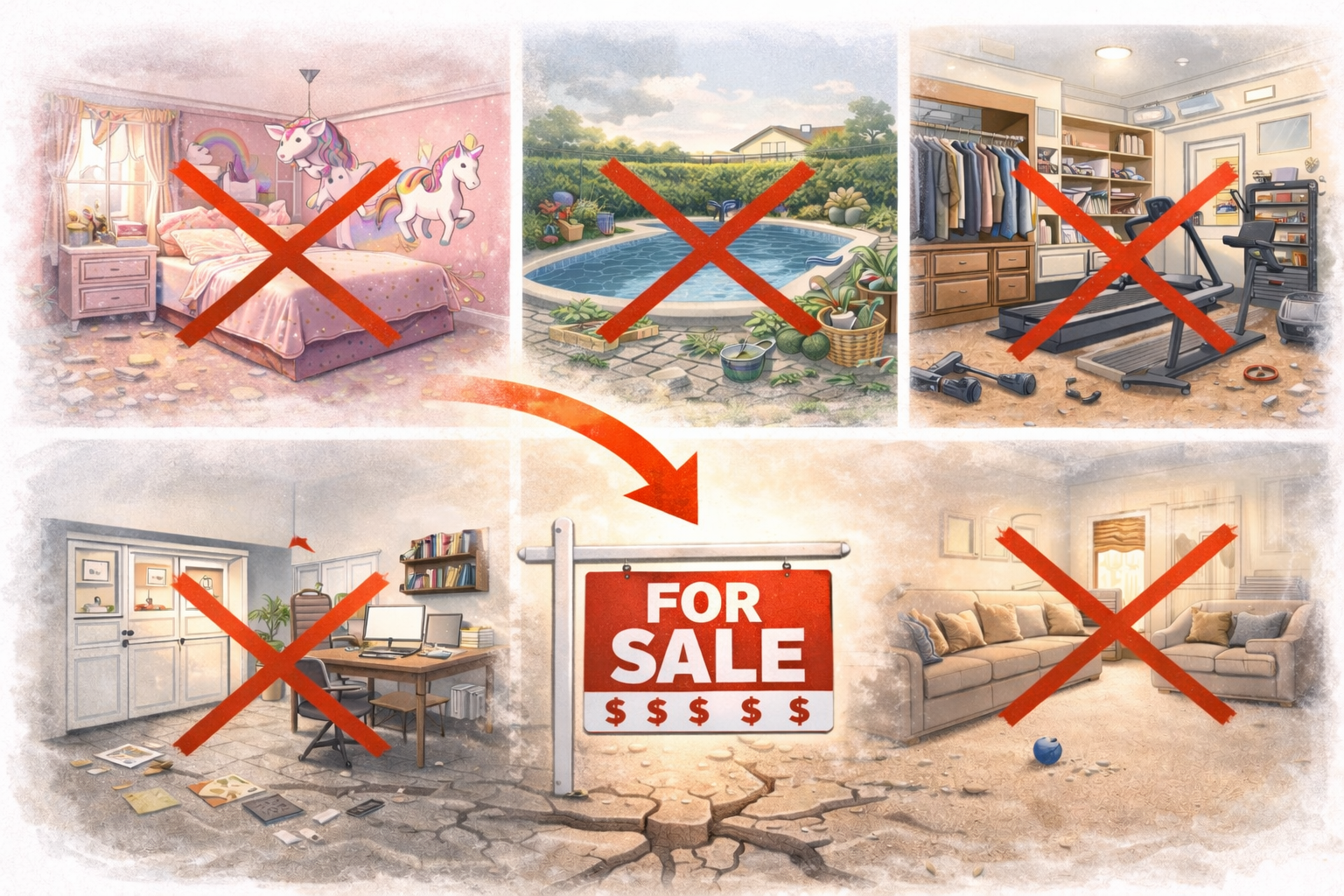
Your daughter might have loved the bubblegum pink walls in her bedroom. Future buyers? Not so much.
Bold paint colors, themed rooms, ultra-specific designs, specialty materials… these all feel like upgrades when they match your taste. But most buyers just see the cost and hassle of undoing them.
This goes beyond paint colors. Custom murals, highly specific tile patterns, built-ins designed around your furniture… anything that screams “this was made for someone else” creates friction for buyers. They’re mentally adding up the cost of making it theirs, and that math works against you.
The rule of thumb: the more personal the choice, the smaller the pool of buyers who will appreciate it. Neutral isn’t boring. Neutral is marketable. The goal is to give buyers a canvas they can project their own vision onto, not a finished painting they didn’t choose.
2. High-Maintenance Features
Anything that adds recurring work or expense can turn off buyers. If it makes the home harder to own, buyers will either walk away or discount their offer to compensate.
Elaborate landscaping that requires constant upkeep. Oversized decks that need regular staining. Hot tubs and pools in markets where they’re more hassle than amenity. These features feel like luxuries until you’re the one maintaining them… or trying to sell to someone who doesn’t want to.
Pools are the classic example. In warm climates with long summers, a pool can add value. In northern markets with short swimming seasons, a pool is often a liability. Buyers see the maintenance costs, the safety concerns, the insurance implications. Many actively avoid homes with pools.
Before adding anything that requires ongoing care, ask yourself: would I want to inherit this from the previous owner? If the answer is “only if I’m really into this specific thing,” that’s a sign it might hurt more than help at resale.
3. Reducing the Bedroom Count
Buyers pay for bedrooms. It’s one of the first filters people use when searching for homes. Three bedrooms versus four bedrooms puts you in completely different buyer pools.
Converting a bedroom into a walk-in closet, a home gym, or an expanded primary suite might suit your lifestyle perfectly. But it can significantly reduce your home’s value and shrink the number of potential buyers.
This is one of the most expensive mistakes homeowners make. They optimize for how they live now without thinking about what it costs them later. That extra closet space or larger master bathroom might add $10,000 of value to you personally, but losing a bedroom could cost you $30,000 or more at resale.
The math rarely works in your favor. If you need more closet space or a bigger bathroom, find ways to get it without eliminating a bedroom entirely. Future you (and your real estate agent) will thank you.
4. Garage Conversions
Some homeowners convert their garage into a bonus room, home office, or gym. They assume every buyer will see the value in extra living space.
They’re often wrong.
Garage storage ranks among buyers’ top priorities. It’s consistently one of the most desired features in single-family homes. When you remove that functionality… especially if you take out the garage door… you lose one of the home’s most practical and widely valued features.
A garage is flexible. Buyers can use it for cars, storage, a workshop, or eventually convert it themselves if they want to. A converted garage is a decision someone else made for them. Most buyers don’t like that. They see a space that’s lost its original purpose and wonder how much it would cost to restore it.
If you need a home office or gym, consider whether there’s another space in the house that could work. The garage should usually stay a garage.
(article continues below)
Real estate investments? Awesome.
Being a landlord? Less fun.
Learn how to earn 15%+ on passive real estate investments in our free video course.

5. Wall-to-Wall Carpeting
This one surprises people. Isn’t carpet an upgrade over bare floors?
Not usually. And in many cases, it’s actively working against you.
Carpet traps allergens, absorbs odors, and wears visibly over time. Even new, neutral carpet can raise red flags for buyers. They wonder if you’re covering up damage to the subfloor or hiding pet stains or other issues underneath. It creates suspicion rather than confidence.
Data from real estate sales suggests homes with carpet sell for 1% to 3% less than comparable homes with hard flooring. On a $400,000 home, that’s $4,000 to $12,000 in lost value. That’s a meaningful hit on a major asset.
Hard floors… hardwood, luxury vinyl plank, tile… are easier to clean, longer-lasting, and appeal to a broader range of buyers. They photograph better for listings. They don’t hold smells. And buyers can always add rugs if they want softness underfoot.
If you’re choosing between carpet and hard floors, hard floors almost always win for resale value.
(article continues below)
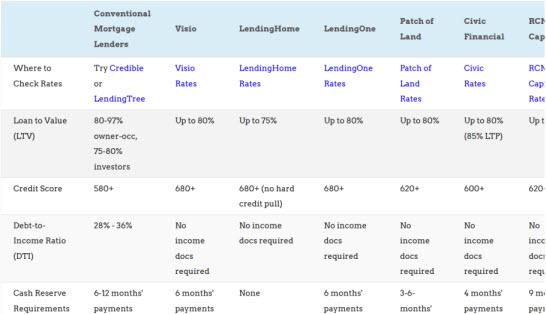 What short-term fix-and-flip loan options are available nowadays?
How about long-term rental property loans?
We compare several buy-and-rehab lenders and several long-term landlord loans on LTV, interest rates, closing costs, income requirements and more.
The Underlying Principle
Buyers want to make a home their own. They want a blank canvas, not someone else’s finished painting.
The upgrades that hurt resale value almost always share one trait: they reflect a specific owner’s preferences rather than broad market appeal. Bold colors, niche features, reduced flexibility, high maintenance… these all narrow the buyer pool. And a smaller buyer pool means less competition, which means lower offers.
Before making any significant modification, ask two questions. First: will this appeal to most buyers, or just me? Second: am I adding value, or am I adding something the next owner will want to undo?
The best home improvements are the ones that increase functionality, reduce maintenance, and appeal to the widest possible audience. Updated kitchens and bathrooms with neutral finishes. Fresh paint in crowd-pleasing colors. Hard flooring. Good lighting. These are the upgrades that actually pay off.
Everything else is personal preference… which is fine, as long as you’re not expecting to get that money back when you sell. Enjoy your pink walls or your backyard pool. Just go in with realistic expectations about what they’ll mean when it’s time to move on.
About the Author

G. Brian Davis is a real estate investor and cofounder of SparkRental who spends 10 months of the year in South America. His mission: to help 5,000 people reach financial independence with passive income from real estate. If you want to be one of them, join Brian and Deni for a free class on How to Earn 15-25% on Fractional Real Estate Investments.
Connect with us on social!