Group-Vetted Real Estate Investments — Without Becoming a Landlord
Join a community that reviews passive real estate deals together every month, and invest in the ones you like with lower minimums.

 Why Investors Join the Co-Investing Club:
$2,500–$5,000 minimums instead of typical $50K–$100K syndication, fund, or JV partnership minimums
Group vetting: Analyze deals together on group calls before deciding
Deal flow: New passive investments featured every month
Diversification: Across geographical markets, asset classes, operators, and timelines
Aligned interests: We invest personally alongside members
Non-accredited investors welcome
How the Co-Investing Club Works
Attend live deal reviews
Once or twice a month, our Co-Investing Club meets to vet deals together. No experience necessary, recordings available.
Choose whether to invest
Invest $2,500 or more in the investments you like, instead of the typical $50,000-$100,000. Non-accredited investors welcome.
Fund the joint LLC
Transfer your funds to the joint bank account (which you get “View” access to), get listed as a partial owner of the joint LLC.
Get cash flow, appreciation, tax benefits
Enjoy full benefits of real estate ownership. We vet deals targeting 14%+ returns — together, as a club.
Deals Invested In
Avg. Targeted Annual Returns
States Invested In (+1 Canadian Province)
Where Our Real Estate Investment Club Has, Well, Invested!
Curious about what kinds of group real estate investments we make? Here’s a map of the 47+ properties where we’ve invested so far:
What kinds of investments do we review as a club?
Multifamily
Hotels & Airbnbs
Secured Loans
Mobile Home Parks
Self-Storage
Industrial
Curious about past investments’ performance?
Here’s every deal we’ve ever invested in — and how it’s performed.
Ready to Start Investing as a Community?
Join the Co-Investing Club to invest passively in real estate with a fraction of the typical investment minimum. View all past Club investments and their performance here.
And if you decide it’s not for you, we have a no-questions-asked refund policy 😊
Choose your plan
- We vet 1 or 2 new deals monthly on a live Zoom call, where we all grill the operator together then discuss after they drop off the call.Vet deals together as a club
- All deals optional — you participate in any group investments you like.Minimum investment (all deals optional)
- Access to Club vetting tools and private Facebook Group
- Member discounts for either RocketDollar or IRA ClubDiscounts on SDIRA custodians
- In a small group, we workshop your personal goals and help you find your blind spots and blocks.Quarterly Mastermind Accelerator
- Automated returns tracker
- Get started with professional tax, investing, legal and financial strategies.2 Free Strategy Sessions with Financial Advisor
- Collection of class recordings on topics like SDIRAs & solo 401(k)s, advanced tax strategies, niche investments and moreVIP Knowledge Vault access
- Wealth tracking and planning platformDiscount on Vyzer
- Tax strategy, investment strategy, estate planning, insurance & risk strategy, and much more with financial advisor Michael Harris of Emory Wealth.Fractional Family Office
Investor
$49.25/mo ($597 annual)
or $69 monthly
- Live calls + recordings
- $5,000
- Join Yearly
- Join Monthly
VIP Investor
$79.75/mo ($957 annual)
or $99 monthly
- Live calls + recordings
- $2,500
- 20% off
- Join Yearly
- Join Monthly
Fractional Family Office
$4,997/year
- Live calls + recordings
- No minimum
- 20% off
- Join Yearly
New Membership Closes In:
Day(s)
:
Hour(s)
:
Minute(s)
:
Second(s)
 No-Questions-Asked Refund Policy
The Co-Investing Club is not for everyone.
Join the Club, attend a meeting or two, and if you decide it’s not for you, we’ll refund your membership dues with no questions asked.
Seriously, we only want people in the Co-Investing Club who are excited to invest in deals together. It’s that simple.
Club will accept new members within the next 3 weeks!
No-Questions-Asked Refund Policy
The Co-Investing Club is not for everyone.
Join the Club, attend a meeting or two, and if you decide it’s not for you, we’ll refund your membership dues with no questions asked.
Seriously, we only want people in the Co-Investing Club who are excited to invest in deals together. It’s that simple.

Don’t take our word for it. In our members words:



FAQ About Group Investing in Real Estate
Still have questions? We’ve got you covered.
Can I invest under an entity name such as an LLC, in these group real estate investments?
Yes, you can invest through our real estate investment club using a legal entity such as an LLC or S-corp.
Can I invest through the real estate investment club with my self-directed IRA?
Yes. We have members who routinely invest through their self-directed IRAs, and you can do likewise with most self-directed 401(k)s.
How are taxes handled?
We open a new LLC for each deal, and you get listed as a partial owner of the LLC. You’ll receive your own K1 at tax time each year.
Participating members pay $75 a year to cover the joint LLC accounting and administrative costs.
How do Club costs impact returns?
The Co-Investing Club comes with two types of costs:
-
- Membership Fee: $59/month or $597/year. This grants you access to participate in deals alongside other investment club members. You can end your Co-Investing Club membership at any time.
- Joint LLC Accounting & Administrative Costs: $75/participant/year (or we can outsource it to Tribevest for $150, which is determined by vote for each deal). We create a joint LLC for each investment that we go in on together. These come with a lot of costs, from opening and renewing the LLC to filing LLC tax returns to creating K1s or 1099-INTs for every participant. It also takes a ton of labor on our part, opening the joint bank account, giving all members access to it, coordinating with the deal operator on getting tax forms and updates, etc.
Our aim is for the returns from a single deal to more than cover these costs every year. For example, say you invested the minimum $10,000 and earn a 15% return, that’s $1,500. That’s more than double the annual membership ($597) and the joint LLC cost ($75) of $672 total.
And of course, the idea is consistent investing with smaller amounts. The more you invest, the less these flat costs eat into your returns. If you invested $10,000 a quarter at similar returns, that would come to $6,000. If you invested $30,000 a quarter, that would come to $18,000. And so on.
Investing smaller amounts through a group LLC comes with slightly higher cost than going it alone. We know firsthand that being part of an organized community of investors, with consistent deal flow every few works, has enormous value.
Does SparkRental get a cut of the returns on these investment club deals?
No. We earn our money through investment club membership fees. We do charge operators an administrative fee, but that comes out of their pockets, not our members’ returns.
Deni and Brian invest as club members themselves, as equal participants and passive investors.
Can non-US citizens invest as a member of this real estate investing club?
Yes, but you need a U.S. bank account to transfer and receive funds. You need a taxpayer ID number in the U.S., which you can get by creating an LLC and getting an EIN.
Can spouses invest together in these group real estate investments, with both names listed?
Yes, we can list spouses together as investors.
What’s the difference between group real estate investments and a REIT?
You can buy and sell shares of real estate investment trusts (REITs) on public stock exchanges. They come with great liquidity, and you can invest for the price of a single share. That makes them an easy way to get started on a diversified portfolio of real estate assets.
But that same liquidity from trading on stock exchanges comes with some drawbacks too. Publicly traded REITs come with volatility and they correlate with stock markets. And, because anyone can invest with just a few dollars, you can’t expect outstanding returns.
Fractional ownership in real estate through syndications involves private equity investing, historically only available to the rich. In other words, you aren’t competing with every Tom, Joe, and Harry for returns.
How are real estate syndications different from real estate crowdfunding?
That said, real estate crowdfunding often offers similar types of real estate properties including apartment buildings, commercial properties including industrial or office buildings, and even single-family homes and vacation properties. Individual investors who don’t yet have $5,000 to invest should consider starting with crowdfunding platforms such as Fundrise, Groundfloor, or Arrived, which let you get started with $10-100.
How much passive income can I expect from fractional ownership in real estate?
No returns are guaranteed, all investments have risk, yada yada yada. Now to answer your question:
Some income-oriented investments pay 10-16% yields. Other growth-oriented investments pay no distributions, at least for the first year or two while they’re building or stabilizing the property. And some offer a mix of income and growth, with yields between 4-8% on these group real estate investments.
On deals paying distributions, participants receive their share quarterly.
If the sponsor refinances the property and returns some or all of your initial investment back to you, you can expect your yield to leap even as the actual dollar amount of distributions drops.
Are there any other costs associated with investing through the Co-Investing Club?
Each joint LLC comes with its own accounting and administrative costs. Participants in each deal typically vote on whether to outsource this work to a third party or handle the work in-house. If the latter, it costs $75/year per participant.
What type of legal entity or structure do you use for fractional property ownership?
We create a Pennsylvania LLC (limited liability company) for each deal, to jointly hold our collective ownership. We then create a joint checking account for that LLC, used only for that single property or deal. Ideally, someone steps up to serve as treasurer and oversee distributions to each member.
Who handles property management on these fractional real estate investing deals?
It depends on the deal. Some sponsors have an in-house property management team, others outsource to a property management company. Either way, expect similar costs for property management fees.
We’re real estate people. Not marketers, not faceless, not corporate.
Deni Supplee and G. Brian Davis, our quirky and brilliant founders, show up just about everywhere in the world of real estate investing. Every week we appear somewhere in the press or other media appearances, and we make ourselves available for open Zoom calls every Thursday at 3:30 EST.


Deni Supplee and G. Brian Davis love real estate, passive income, lifestyle design, and teaching.
So we combined all those together in SparkRental.
Some people just want the high returns and tax benefits of real estate investments, but don’t want the headaches of becoming a landlord. For them, we created our Co-Investing Club to help them invest passively in real estate.
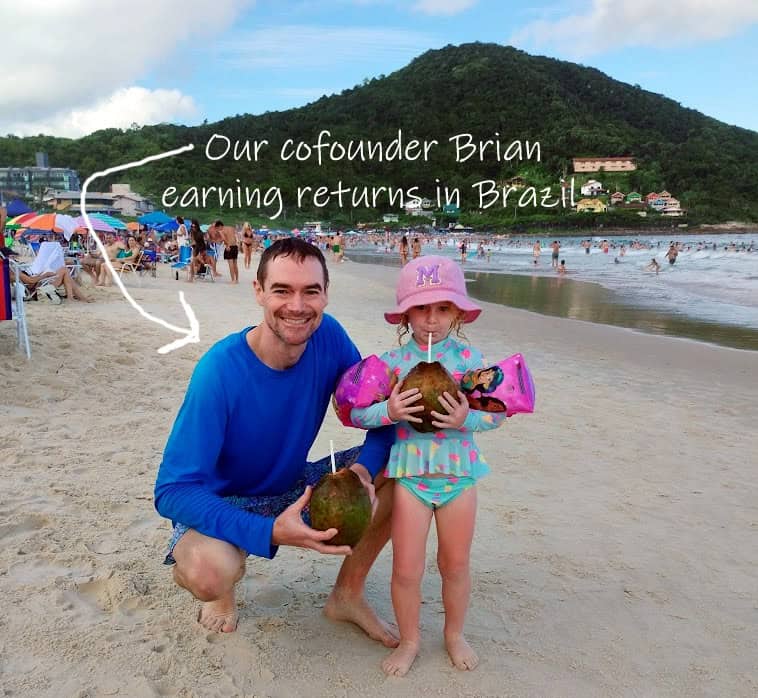
In fact, Brian’s now one of those passive investors, after spending ten years traveling overseas with his wife Katie and daughter Millie.
Other investors want the control of owning individual properties directly. For them, we created free landlord software, free calculators (such as a free rental income calculator and free depreciation calculator), and interactive maps such as the best cities for rentals and real estate heat maps.
With enough passive income from real estate, you reach financial independence. You can live off your rents and distributions — and your day job becomes optional.
Want to connect? Drop us a line below, or check out our Facebook page and YouTube channel!