The Short Version:
-
- Goldman Sachs projects 67% of Trump’s tariff costs land on US consumers alone by July 2026… and that number has a direct and underappreciated effect on real estate demand
- Tariffs raised the cost of building a new single-family home by roughly $9,200, which means affordable housing supply tightens further while the demand side stays exactly where it was
- Charles Schwab’s 2026 market outlook identified a “K-shaped economy”… and the group that feels financially confident is sitting on a portfolio that’s more fragile than it looks
- Real estate income streams don’t move with tariff headlines or Fed commentary… and I explain exactly why that correlation difference matters more than most investors realize
- I’m a real estate person, not an oil person… but I invested in Texas oil wells this year anyway, and the reason has everything to do with how inflation treats different types of passive income differently
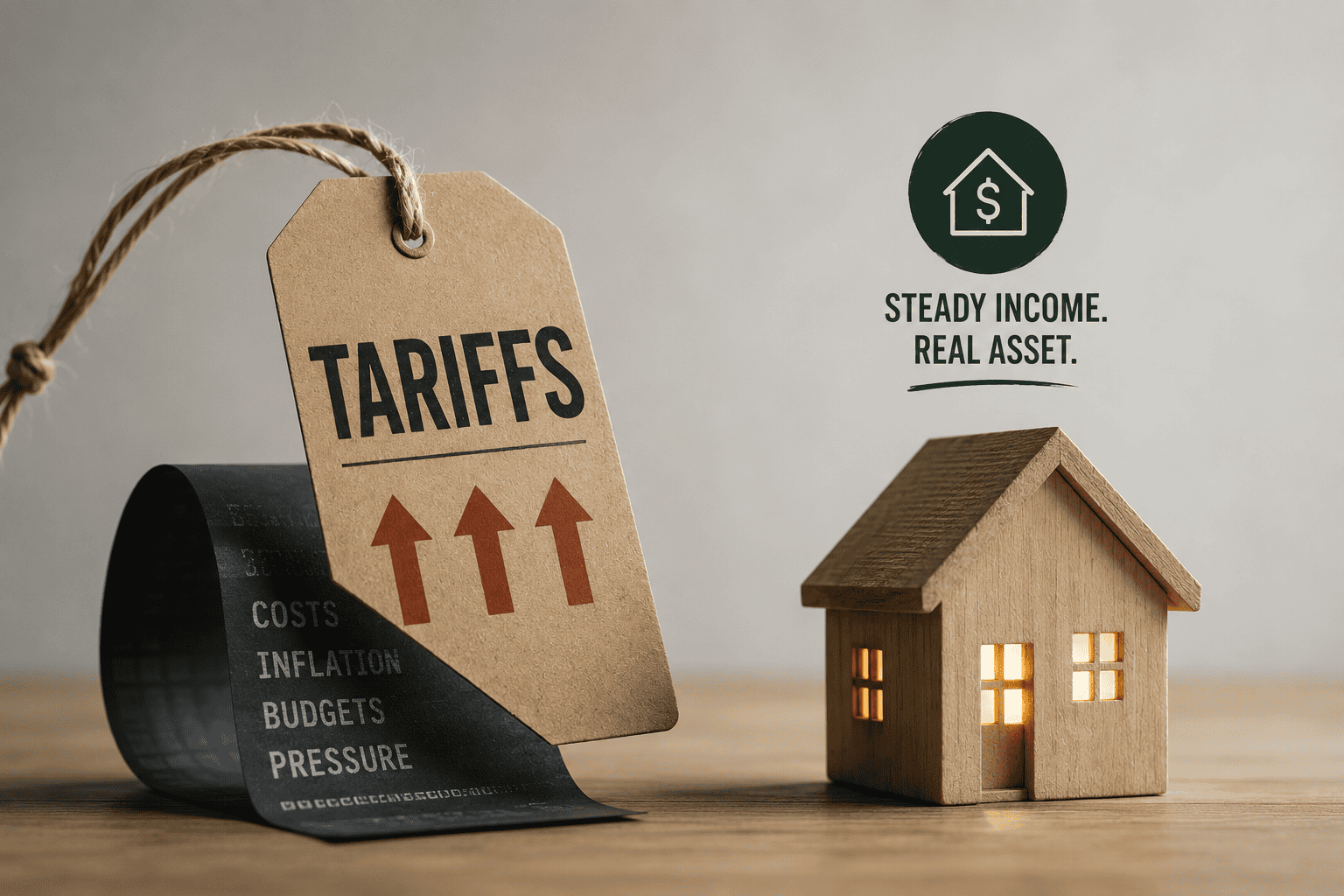
Goldman Sachs ran the numbers on Trump’s tariffs. Their finding: US companies and consumers collectively absorbed 82% of the tariff costs in October 2025. By July 2026, Goldman projects that 67% of the burden falls on consumers alone.
That’s not an abstract policy number. That 67% shows up in grocery bills, appliance prices and the monthly squeeze on household budgets that’s been compounding for the better part of three years now.
The Institute for Supply Management adds more texture to the picture. US manufacturing activity contracted for nine consecutive months through early 2026. Unemployment sits at a four-year high. Hiring slowed more sharply in 2025 than any year since the Great Recession, excluding the pandemic.
Most investors read headlines like this and wonder whether to rebalance their stock portfolio. Here’s why I think passive real estate investors are reading the same headlines and seeing something very different.
What Tariffs Actually Do to the Housing Market
The conventional fear around tariffs and real estate runs like this: tariffs raise construction costs, higher costs reduce new supply and reduced supply worsens affordability. That chain of logic holds up.
Lumber, steel, aluminum and appliances all face import tariffs at various rates. The National Association of Home Builders put the tariff-driven cost increase per new single-family home at roughly $9,200 in early 2026. That doesn’t stop construction entirely. It slows it and shifts the economics toward higher-end builds where margins can absorb the hit.
The net effect: affordable and workforce housing supply tightens further while demand stays strong. People who can’t afford to buy keep renting. People who might have bought a $280,000 starter home find it now costs $310,000 and pencils differently at current mortgage rates. They rent instead.
That dynamic has been building since 2022. Tariffs accelerate it.
The Persistent Renter Reality
Here’s the number that matters most for passive real estate investors right now.
Median home prices nationally hover near all-time highs around $364,000, according to Zillow data from early 2026. The 30-year fixed rate still sits above 6%. Household income growth hasn’t kept pace with either of those numbers since the pandemic.
The result: a growing cohort of Americans who’ve become persistent renters. They’re not renting because they prefer it. They’re renting because the math on buying doesn’t work for them… and it won’t work in the near term regardless of what happens to interest rates.
That cohort needs somewhere to live. They want space… ideally a single-family home experience, or at minimum a well-maintained apartment in a neighborhood with decent schools and reasonable commutes. They’ll pay market rent for it. What they can’t do is produce a $60,000 down payment and qualify for a mortgage that costs more than their current rent.
Workforce housing in middle America serves exactly that cohort. The Clevelands, the Columbus’s, the mid-sized metros with diverse employment bases and median household incomes between $55,000 and $85,000. Deni and I have invested in several deals fitting that profile through the co-investing club over the past couple of years. The distribution yields have held consistently. The operators running those properties report waiting lists, not vacancy problems.
That’s the environment tariffs are reinforcing… not creating from scratch, but reinforcing and extending.
(article continues below)
Real estate investments? Awesome.
Being a landlord? Less fun.
Learn how to earn 15%+ on passive real estate investments in our free video course.

Why Stocks Don’t Offer the Same Protection
Charles Schwab’s 2026 outlook described what they called a “K-shaped economy.” High-income households, buoyed by three consecutive years of S&P 500 double-digit gains, feel relatively confident. Lower-income households, grinding against sticky inflation and a weakening labor market, feel the squeeze.
The problem for the confident group: their confidence rests on a stock portfolio that moves with macro headlines. Tariff announcements, Fed commentary, geopolitical flare-ups… each one sends ripples through equities. The S&P 500 has continued advancing in 2026 but Morgan Stanley notes that markets have already priced in a lot of anticipated good news, suggesting upside from here looks more limited with valuations stretched.
Passive real estate investments don’t behave like that. A syndication that owns 200 units of workforce housing in a mid-sized metro doesn’t care what the Fed said this week. The rent rolls don’t move with market sentiment. Distributions get paid because tenants pay rent… not because investor confidence held up through the month.
That’s not an argument for abandoning equities. It’s a description of correlation. Real estate income streams and stock returns don’t move together in the same direction at the same time. That’s precisely what true diversification accomplishes… and what most six-figure investors who hold primarily index funds haven’t actually built into their portfolios yet.
The Inflation Angle That Usually Gets Missed
Tariffs create a specific flavor of inflation… cost-push, driven by import prices rather than excess consumer demand. The Fed’s preferred inflation measure has stayed above the 2% target for four and a half years. Schwab’s economists don’t see that changing materially in 2026.
Inflation running at 3% over a decade quietly cuts the purchasing power of a dollar by around 26%. A portfolio sitting in cash or bonds loses ground every year. Stocks can hedge inflation if earnings grow faster than prices… but that relationship gets unreliable during periods of cost-push inflation specifically.
Real estate has a different relationship with inflation. Rents tend to move with broad price levels over time. An operator who owns workforce housing in 2026 can raise rents in 2027 because the cost of living in that market went up. The income stream inflates with the environment rather than against it. The underlying asset… the physical building… tends to appreciate in inflationary environments because replacement costs rise alongside construction input prices.
I’ll mention the oil wells deal here too because it fits. Deni and I are real estate people… we say that all the time. But earlier this year the co-investing club invested in a working interest in a portfolio of Texas oil wells. We did it because commodity prices that determine distribution yields on energy deals tend to correlate positively with inflation.
We also did it because of the tax treatment: most real estate depreciation can only offset other passive income, not W-2 income. Working interest deductions can offset active income, including your salary. For a high earner in the 35% or 37% bracket, that changes the after-tax math significantly. It’s unusual enough that we felt it warranted a closer look despite not being our usual lane.
(article continues below)
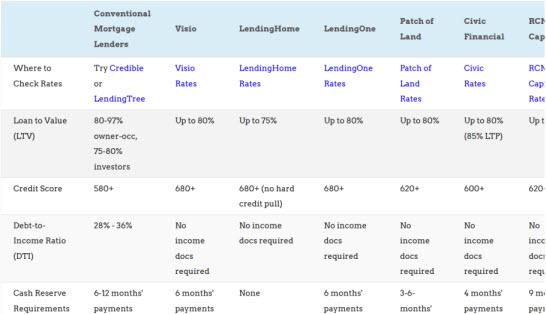 What short-term fix-and-flip loan options are available nowadays?
How about long-term rental property loans?
We compare several buy-and-rehab lenders and several long-term landlord loans on LTV, interest rates, closing costs, income requirements and more.
What to Actually Do With This Information
The answer here isn’t dramatic. It doesn’t require selling your index funds or making a panicked decision because Goldman Sachs ran some tariff math.
The relevant question is simpler: what percentage of your net worth currently generates income that has no relationship to what the stock market does this month? For most high-income professionals, that number sits close to zero. Their 401k tracks the S&P. Their savings account yields less than inflation. They have no passive income streams running independently of how equities perform.
Building one doesn’t require a massive initial commitment. In the co-investing club, Deni and I vet a new passive real estate deal every month… syndications, debt funds, secured notes, occasionally energy or land structures depending on what passes our underwriting. Members participate starting at $5,000 per deal.
The goal of the first position isn’t to retire on it. The goal is to start understanding how these deals work, what good underwriting looks like and how passive income behaves differently from a stock dividend during a rough market stretch. That knowledge compounds alongside the capital.
Tariffs, inflation, unemployment, a K-shaped economy… none of this signals that the world is ending. It signals that the environment has gotten more complex and that a portfolio built entirely on one kind of asset is more fragile than it looks on a good day. Real estate income holds up in complex environments because the underlying need… somewhere to live… doesn’t disappear when trade policy gets messy. Most investors just haven’t priced that durability into their portfolio yet.
About the Author

G. Brian Davis is a real estate investor and cofounder of SparkRental who spends 10 months of the year in South America. His mission: to help 5,000 people reach financial independence with passive income from real estate. If you want to be one of them, join Brian and Deni for a free class on How to Earn 15-25% on Fractional Real Estate Investments.
Connect with us on social!