The Short Version:
-
- High earners hand nearly 40 cents of every additional dollar to the government… while passive real estate investors collecting real cash distributions often pay close to zero on that income
- The tax code treats real estate fundamentally differently than stocks or bonds, and Congress built these provisions in on purpose. Most investors never learn why
- Depreciation lets you collect actual cash flow while reporting a paper loss to the IRS. Cost segregation and bonus depreciation amplify that benefit dramatically in year one
- A 10% gross return sheltered by depreciation can deliver the same after-tax outcome as a 14-15% return on a taxable investment. That gap compounds quietly over a decade

Here’s a number that should bother anyone earning a good income: on every additional dollar of W-2 earnings above roughly $200,000, you’re paying close to 40 cents to the government when you factor in federal and state taxes.
You worked for that dollar. You earned it. And nearly half of it is gone before you can do anything with it.
Now here’s a different number. Many passive real estate investors who are collecting real cash distributions from their investments… quarterly checks showing up in their accounts… are paying close to zero in taxes on that income.
Same country. Same tax code. Completely different outcomes.
The difference isn’t a loophole or a gray area. It’s a set of provisions in the tax code that were deliberately designed to encourage private investment in real estate. Most people never learn them because the financial industry that profits from selling stocks, bonds, and mutual funds has little incentive to explain why real estate is treated differently.
Here’s a plain-English explanation of how it actually works.
Why the Tax Code Rewards Real Estate
The government wants private capital flowing into real estate. Housing, commercial space, industrial infrastructure… these things require enormous investment to build and maintain, and the government would rather private investors do it than taxpayers.
So Congress created a set of incentives. The most powerful is depreciation: the ability to deduct the gradual wear and tear of a physical asset from your taxable income, even while that asset is actually holding or increasing its value.
In practice, this means a real estate investor can collect real cash flow from a property while simultaneously reporting a paper loss for tax purposes. The building generates income. The depreciation offsets that income on paper. The investor pays little or no tax on distributions they’re actually collecting.
It sounds counterintuitive. It’s perfectly legal. The IRS wrote the rules.
How Depreciation Works Inside a Syndication
When you invest passively in a real estate syndication, the operator depreciates the asset over time according to IRS schedules. Residential properties depreciate over 27.5 years. Commercial properties over 39 years.
As a passive investor, you receive a K-1 tax form each year that reflects your share of that depreciation. That depreciation becomes a paper loss that offsets your share of the income generated by the investment.
So even if the deal distributes 8% annually to investors, the K-1 may show little to no taxable income… or even a net loss on paper… depending on the depreciation in that year.
That paper loss doesn’t disappear if it exceeds your investment income. It carries forward and can offset future passive income from other investments. Over time, a portfolio of passive real estate positions can generate significant paper losses that shelter real cash flow from taxation.
Cost Segregation: Accelerating the Benefit
Standard depreciation schedules spread the deduction across 27.5 or 39 years. Cost segregation is a strategy that speeds that up considerably.
Here’s the idea. A building isn’t one uniform asset. It’s a collection of components: the structure itself, the electrical systems, the flooring, the landscaping, the parking lot, the appliances. Each component has a different useful life under IRS rules.
A cost segregation study, done by an engineer who specializes in this, breaks the building into its components and reclassifies shorter-lived items into 5, 7, or 15-year categories rather than 27.5 or 39 years. This front-loads a significant portion of the depreciation into the early years of ownership, when the tax benefit is most valuable.
For a $5 million apartment building, a cost segregation study might reclassify $800,000 to $1.2 million of the value into accelerated categories. Instead of that deduction trickling in over decades, a large portion hits in years one through five.
For passive investors in a syndication, the benefit flows through on the K-1. The operator typically discloses upfront whether they plan to do a cost segregation study, and in our experience, quality operators almost always do.
Bonus Depreciation: The Amplifier
Cost segregation identifies which components can be accelerated. Bonus depreciation determines how much of that accelerated amount you can deduct immediately.
For several years following the 2017 Tax Cuts and Jobs Act, bonus depreciation allowed investors to deduct 100% of certain accelerated components in year one. That provision has been phasing down: 80% in 2023, 60% in 2024, 40% in 2025, 20% in 2026.
Even at 20% in 2026, this is still a meaningful benefit. And there is ongoing legislative discussion about restoring higher levels of bonus depreciation, so this is worth watching.
The practical effect: in the first year of a syndication that uses cost segregation and bonus depreciation together, a passive investor might receive a K-1 showing a paper loss that substantially offsets their distributions. Sometimes the paper loss exceeds the distributions entirely.
(article continues below)
Real estate investments? Awesome.
Being a landlord? Less fun.
Learn how to earn 15%+ on passive real estate investments in our free video course.

The Passive Activity Rules (The Catch)
Here’s the important caveat, and it’s worth understanding clearly.
The depreciation losses generated by passive real estate investments are passive losses. Under IRS rules, passive losses can only offset passive income. They cannot, in most cases, be used to offset your W-2 salary or active business income.
So if you’re a physician earning $400,000 in W-2 income and you invest in a syndication that generates $30,000 in paper losses, you generally cannot use those losses to reduce your W-2 tax bill. The losses suspend and carry forward to offset future passive income or gains when the property sells.
There is an exception: the Real Estate Professional designation. If you qualify… which requires meeting specific IRS tests around time spent in real estate activities… passive losses can be used against active income. For some high-earning professionals whose spouses manage real estate full-time, this designation becomes a significant tax planning tool. But it requires real documentation and typically the guidance of a CPA who specializes in real estate.
For most passive investors, the benefit is real but operates differently. The depreciation shelters the cash flow you’re receiving from the investment itself. It doesn’t reduce your day-job tax bill. It does mean that the 8% annual distribution you’re collecting may cost you very little in taxes… which meaningfully improves the after-tax return compared to what the headline number suggests.
What does this mean in practice?
Stocks generate income in two forms: dividends and capital gains. Both are taxable. Qualified dividends get favorable rates, but they’re still taxed. Capital gains are taxed when you sell.
Real estate generates income that can be sheltered, deferred, and ultimately stepped up at death in ways that stocks simply cannot replicate. The depreciation benefit, the cost segregation strategy, and the bonus depreciation provision all exist specifically for real estate. Congress built them in on purpose.
This is why serious wealth builders keep coming back to real estate regardless of interest rate cycles or market conditions. The after-tax math is structurally better than what publicly traded securities offer.
A 10% gross return on a passive real estate investment, sheltered by depreciation, might deliver an after-tax return equivalent to a 14-15% return on a taxable investment. That gap compounds dramatically over a decade.
(article continues below)
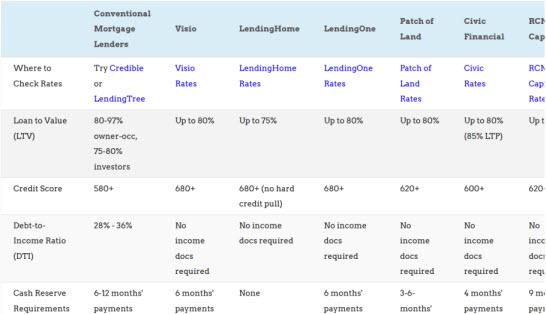 What short-term fix-and-flip loan options are available nowadays?
How about long-term rental property loans?
We compare several buy-and-rehab lenders and several long-term landlord loans on LTV, interest rates, closing costs, income requirements and more.
Conclusion
The tax advantages of passive real estate aren’t a secret, but they are widely misunderstood, and the financial industry that earns fees on stocks and mutual funds has no particular interest in explaining them clearly.
If you’re a high earner who has spent years watching a significant portion of your income go to taxes… and if you’ve been investing primarily through taxable accounts in stocks and index funds… the comparison to what passive real estate investors experience is worth sitting with.
This isn’t about avoiding taxes illegally. The IRS wrote these rules. It’s about understanding what the code rewards and positioning yourself accordingly.
The investors who do this well aren’t necessarily smarter. They just learned earlier that the rules aren’t the same for every asset class.
About the Author

G. Brian Davis is a real estate investor and cofounder of SparkRental who spends 10 months of the year in South America. His mission: to help 5,000 people reach financial independence with passive income from real estate. If you want to be one of them, join Brian and Deni for a free class on How to Earn 15-25% on Fractional Real Estate Investments.
Connect with us on social!