
The Short Version:
-
- The rental property that ticked every box on a popular checklist and still bled cash… and why that’s more common than people admit
- The category of costs that never appears on a proforma but consistently destroys real estate returns
- Why simple rules work in the conditions they were built for and fall apart the moment those conditions change
- What experienced investors use instead of rules of thumb… and how to start building that same judgment
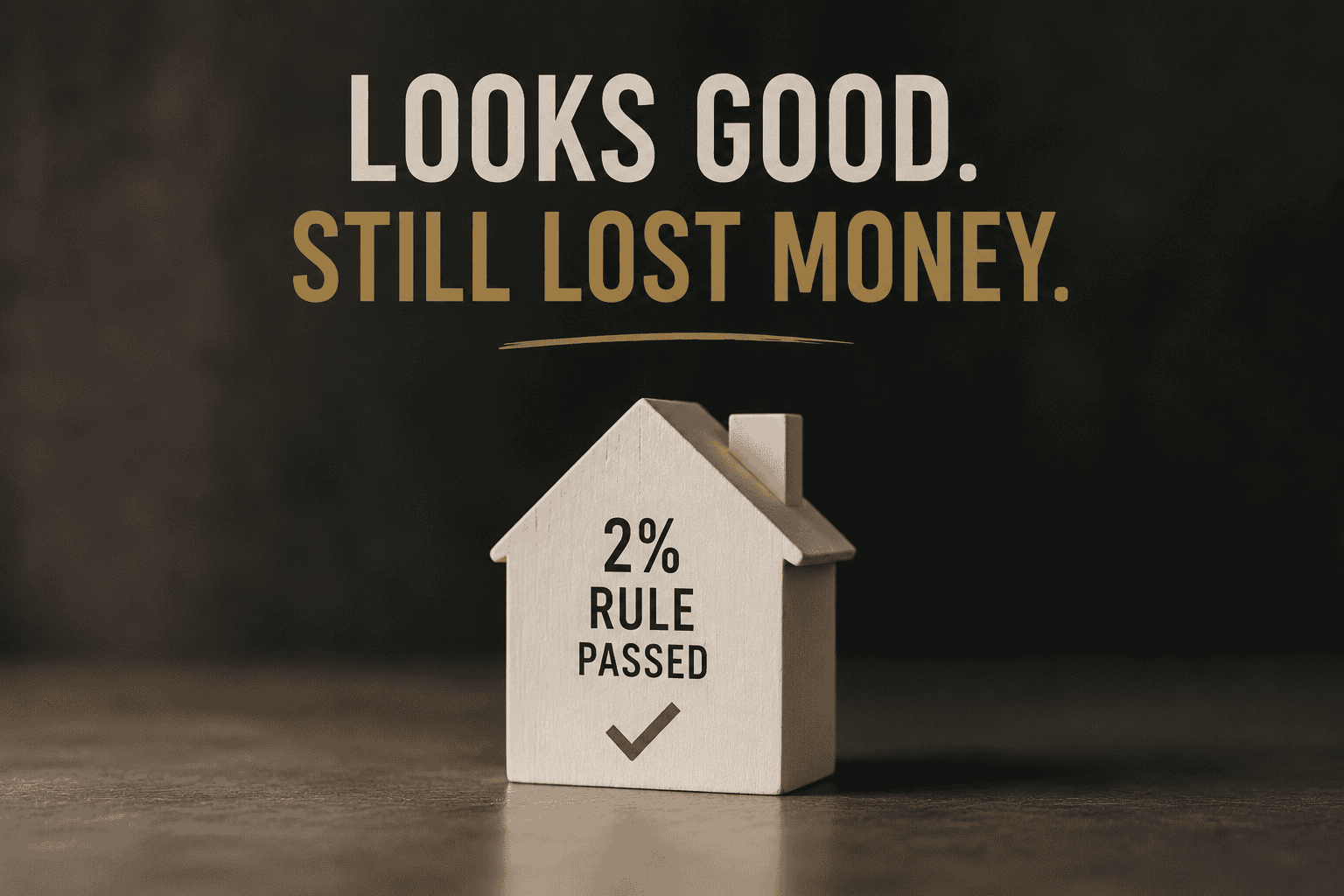
Many years ago, I bought a rental property that passed the 2% rule.
For those unfamiliar, the 2% rule is a shorthand used by real estate investors: if the monthly rent is at least 2% of the purchase price, the deal cash flows. Simple, fast, easy to apply.
The property I bought cleared that threshold comfortably. On paper, the numbers worked. In reality, I lost money on it.
I’ve written about this on BiggerPockets recently, and the reaction told me something: a lot of investors have had a version of this experience, and most of them quietly absorbed the loss without understanding what actually went wrong. So let me explain it clearly, because the lesson here matters more than the specific rule.
What the 2% Rule Is Actually Doing
Rules of thumb in real estate exist for a reason. They give new investors a quick filter. Instead of analyzing every property in depth, you can run a fast calculation and immediately eliminate deals that won’t work.
The 2% rule came out of a specific era in real estate investing, in specific markets, under specific conditions. When properties were cheaper and rehab costs were lower and certain categories of expense were more predictable, 2% rent-to-price was a reasonable proxy for cash flow viability.
The rule was never meant to be the last word. It was a first filter. Somewhere along the way, a lot of investors started treating it as a conclusion.
The Costs That Don’t Show Up on Paper
Here’s what the 2% rule doesn’t capture, and what my property taught me the expensive way.
Property location affects tenant quality. Not as a moral judgment, but as a practical reality. Lower-income neighborhoods produce higher tenant turnover. Higher turnover means more vacancies, more rehab between tenants, more advertising costs, more property management labor. None of this shows up when you run the 2% calculation.
Location also affects the quality of property managers available to you. Skilled property managers are selective. They gravitate toward properties where the math works for them too. In rougher neighborhoods, you end up with the managers who couldn’t attract better clients. I learned this lesson in Baltimore, buying in areas where I couldn’t find a competent, reliable property manager regardless of how hard I looked.
There’s also what I’d call the invisible expense category: things that don’t appear on any proforma because they’re impossible to predict in advance. Copper stripped from AC units. Appliances walked out of vacant units. Good tenants leaving not because of anything you did, but because crime in the neighborhood made the unit feel unsafe. These costs are real. They just don’t fit neatly into a spreadsheet row.
My 2% property had great numbers on acquisition day. By the time I factored in the actual vacancy rate, the actual tenant quality, the actual property manager I could find, and the actual condition I was returning units to between tenants, the deal didn’t work.
The Deeper Problem With Simple Rules
Rules of thumb are calibrated to historical averages in the conditions they were built for. The moment the market changes, the conditions shift, or you apply the rule outside its original context, the reliability degrades.
The 2% rule made more sense when properties in cash-flow markets were selling for $50,000. At $150,000 in the same market, a property generating 2% monthly rent doesn’t produce the same returns once you account for current insurance costs, property tax rates, and maintenance on an older asset. The rule stayed fixed while the underlying math moved.
This is not an argument against using rules of thumb to filter deals quickly. It’s an argument against treating any single metric as a substitute for actually understanding what you’re buying.
Good investors use rules of thumb to eliminate obvious losers. They use judgment, built from experience, to evaluate everything else.
(article continues below)
Real estate investments? Awesome.
Being a landlord? Less fun.
Learn how to earn 15%+ on passive real estate investments in our free video course.

What Replaces the Rule
The investors I’ve watched consistently do well share a common approach. They start with a filter, then go deeper.
Beyond the basic rent-to-price ratio, they’re asking: what does vacancy actually look like in this submarket, not the metro average? What do property managers who work this area say about tenant turnover? What are the realistic maintenance costs on a property of this age and construction type? What are the taxes actually doing, not what the current owner is paying?
They’re stress-testing assumptions. If vacancy is 10% instead of 5%, does the deal still work? If a major repair hits in year two, can it absorb that without going negative? If interest rates stay elevated and the exit cap rate compresses, what does the return look like at disposition?
This kind of thinking takes longer than running a 2% calculation. It also produces dramatically different outcomes. The deals that look great under a rule of thumb and fall apart under scrutiny get eliminated. The deals that survive scrutiny are the ones worth owning.
The Underlying Principle
Simple investing rules exist to make the first cut faster. They are not a substitute for understanding the investment.
Every rule was built in a specific context. When that context holds, the rule works. When conditions shift, markets change, or you move to a different asset type or geography, the rule may still look valid on the surface while producing completely different results underneath.
The investors who get hurt aren’t always the ones who ignored the rules. Sometimes they’re the ones who followed them too faithfully, without ever asking what the rule was actually trying to measure and whether it was still measuring that thing accurately.
(article continues below)
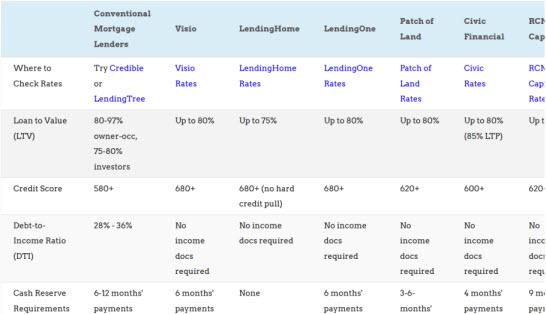 What short-term fix-and-flip loan options are available nowadays?
How about long-term rental property loans?
We compare several buy-and-rehab lenders and several long-term landlord loans on LTV, interest rates, closing costs, income requirements and more.
What I Do Now
I no longer buy rental properties directly. After enough expensive lessons, I made a deliberate shift toward passive real estate investing, where experienced operators do the deep due diligence on every deal before capital goes in.
In our Co-Investing Club, we vet investments together every month. We’re not just running calculations. We’re asking hard questions about operators, debt structure, market conditions and downside scenarios. We’re looking for deals that work under stress-tested assumptions, not just under optimistic ones.
It’s a different approach than buying a property and hoping the numbers hold. And it’s produced meaningfully different results.
About the Author

G. Brian Davis is a real estate investor and cofounder of SparkRental who spends 10 months of the year in South America. His mission: to help 5,000 people reach financial independence with passive income from real estate. If you want to be one of them, join Brian and Deni for a free class on How to Earn 15-25% on Fractional Real Estate Investments.
Connect with us on social!




















Preach. I wish this was communicated more heavily to newer investors. I see them using quick rules of thumb as their only layer of analysis all the time.