The Short Version:
-
- The name financial planners use for the pattern that traps professionals earning $150K-$500K… and why it’s almost impossible to spot from the inside
- Why your last raise almost certainly didn’t improve your financial position at all
- The psychological reason high earners are worse at this than people earning half as much
- The structural fix that works when willpower and budgeting don’t

A financial planner named Ted Jenkin coined a term recently that I haven’t been able to stop thinking about.
Lifestyle loopers.
He uses it to describe a rapidly growing population of Americans between 30 and 50 who earn six figures and are somehow still going nowhere financially. Every raise gets absorbed. Every bonus evaporates. The income climbs. The wealth doesn’t.
I’ve watched this pattern play out for years through SparkRental and the Co-Investing Club. Smart, capable people with impressive salaries who, when you look at their actual financial picture, have very little to show for it. Not because they’re reckless. Because they’re caught in a loop they can’t quite see from the inside.
How the Loop Works
Lifestyle creep is not a new concept. The idea that spending rises with income is well documented. But what doesn’t get talked about enough is how completely natural and justified each individual step feels.
You get a promotion. You move to a better apartment because you can now afford it, and the old one was genuinely a bit cramped. Reasonable.
You get another raise. You lease a better car because your commute is long and you spend a lot of time in it. Reasonable.
Your income climbs further. You start eating out more, traveling more, upgrading more. Each decision is defensible on its own. Together, they form a structure where your expenses perfectly track your income, and the gap between what you earn and what you accumulate stays exactly the same.
The Goldman Sachs finding that about 40% of people earning over $500,000 a year report living paycheck to paycheck isn’t about irresponsibility. It’s about structure. When spending is the default and saving is the afterthought, income alone doesn’t determine financial progress. Behavior does.
Why Willpower Isn’t the Answer
Most financial advice treats this as a discipline problem. Track your spending. Cut the subscriptions. Stop eating out so much. Set a budget and stick to it.
The problem is that this advice fails consistently for high earners. Not because they lack discipline in other areas. Because budgeting and willpower are reactive systems. You’re fighting against the current every month, deciding in the moment whether to spend or save.
And in any given moment, spending usually wins. It’s immediate. It’s concrete. The benefit is right there. The cost of not saving is abstract and distant. Even people who know exactly what compound interest looks like in 20 years still spend the money today.
This is not a character flaw. It’s how human psychology works. We’re wired to prioritize the present. Every financial decision is a battle between the person you are now and the person you’ll be in 20 years, and the person you are now has a significant home-field advantage.
The Structural Fix
The only reliable solution to a behavioral problem is to remove the behavior from the equation entirely.
Pay yourself first is the phrase. Automate the savings. Move the money before you feel it. The version of this that actually works for high earners isn’t a monthly transfer to a savings account you can see and access. It’s routing capital into something that genuinely locks it away.
This is one of the reasons illiquid investments have a real advantage over liquid ones for people with good incomes and lifestyle-creep tendencies. When the money is in an index fund you can sell in two clicks, the temptation to deploy it for something else exists constantly. When it’s committed to a three-to-five year real estate investment, that temptation is gone. The decision was made once, up front, and the money is doing its job in the background while you get on with your life.
I’ve seen this dynamic firsthand through the club. Members who describe themselves as poor savers but have done remarkably well as passive investors, because the investment commitment removes the daily friction. The money leaves. It works. Distributions arrive. The loop breaks.
(article continues below)
Real estate investments? Awesome.
Being a landlord? Less fun.
Learn how to earn 15%+ on passive real estate investments in our free video course.

The Embarrassment Factor
There’s a layer to this that doesn’t come up in most financial writing, and it’s worth naming directly.
High earners are often the least likely to seek financial advice or admit they’re struggling to get ahead. The internal logic is simple: I’m smart enough to earn this much, so I should be smart enough to manage it. Asking for help signals that something is wrong with me, not my system.
So they don’t ask. They manage silently and hope the problem resolves itself when the next raise comes. It doesn’t. The next raise just funds a slightly more expensive version of the same loop.
The professionals I’ve seen actually break out of this pattern share a common trait: they eventually admitted to themselves that their financial instincts had been optimized for earning, not building. Those are different skills. The first gets you the salary. The second gets you the wealth.
The Underlying Principle
The lifestyle looper isn’t a bad person or a reckless spender. They’re someone whose financial structure never caught up to their income.
Every raise fed consumption instead of capital. Every bonus felt too small to invest seriously. Every year of high earning produced the expectation of progress without the actual mechanism to deliver it.
Breaking the loop doesn’t require earning less or living miserably. It requires building a structure where saving is automatic, investment is pre-committed and wealth accumulation happens in the background whether or not you’re paying attention to it.
(article continues below)
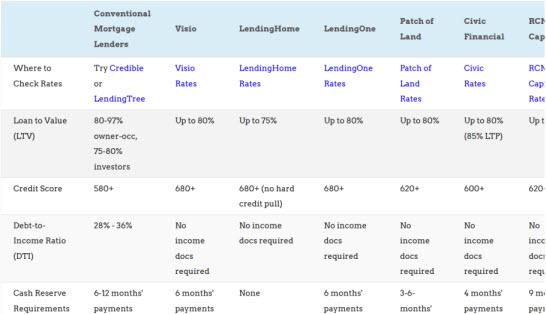 What short-term fix-and-flip loan options are available nowadays?
How about long-term rental property loans?
We compare several buy-and-rehab lenders and several long-term landlord loans on LTV, interest rates, closing costs, income requirements and more.
Where to Start
The first question worth asking honestly is this: if your income disappeared tomorrow, how long could you sustain your current life from what you’ve already built?
If the answer is uncomfortable, that’s useful information. It means the loop is real, and the fix is structural, not motivational.
Start by automating something. A percentage of every paycheck that moves into an investment account before you have a chance to spend it. Then look at where that capital can go. Income-producing assets. Real estate. Private investments. Something that generates a return while you’re not watching.
The goal isn’t to stop living well. It’s to build a financial structure that works as hard as you do, so that eventually, it can work instead of you.
About the Author

G. Brian Davis is a real estate investor and cofounder of SparkRental who spends 10 months of the year in South America. His mission: to help 5,000 people reach financial independence with passive income from real estate. If you want to be one of them, join Brian and Deni for a free class on How to Earn 15-25% on Fractional Real Estate Investments.
Connect with us on social!