The Short Version:
-
- Depreciation is one of real estate’s biggest tax advantages but the IRS wants that money back when you sell. It’s called depreciation recapture, and it catches a lot of investors off guard.
- The depreciation recapture portion is taxed at your ordinary income rate, not the lower capital gains rate. For high earners, that can mean 32-37%.
- If you don’t take depreciation while you own the property, you still owe recapture when you sell. Worst of both worlds.
- There are ways to defer or avoid the hit entirely 1031 exchanges, strategic reinvesting, or holding until death for a stepped-up basis.
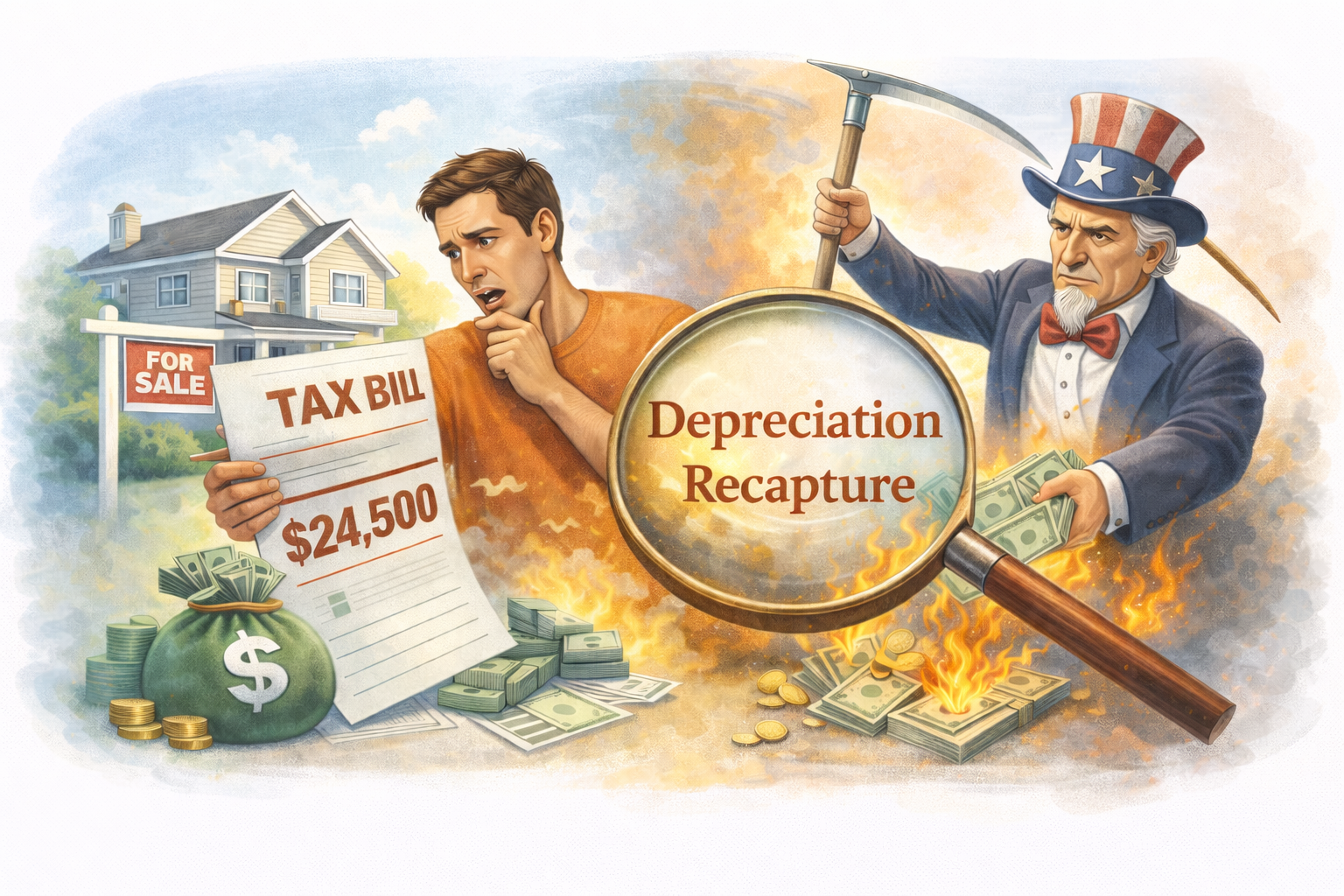
One of the biggest surprises for new real estate investors isn’t a bad tenant or a busted HVAC system. It’s the tax bill when they sell.
They buy a property, hold it for a few years, sell it for a nice profit, and then get blindsided by something called depreciation recapture. Suddenly, that $100,000 gain they were celebrating turns into a much smaller check after Uncle Sam takes his cut.
This happens all the time. And it’s almost always avoidable if you understand how real estate taxes actually work before you start investing.
The Tax Break Nobody Explains Properly
When you own investment real estate, the IRS lets you deduct depreciation every year. It’s one of the biggest tax advantages of real estate investing. You’re essentially writing off a portion of the property’s value each year, even though the property might actually be appreciating.
On paper, this is fantastic. Depreciation can offset your rental income, reducing your tax liability while you hold the property. For many investors, it’s the difference between real estate being a good investment and a great one.
But here’s what most people don’t realize until it’s too late and it’s the fact that the IRS wants that money back when you sell.
What Is Depreciation Recapture?
Depreciation recapture is exactly what it sounds like. The government gave you a tax break while you owned the property. When you sell, they recapture that benefit by taxing you on the depreciation you took.
Let me run through a simple example to make this concrete.
Say you bought a rental property for $100,000. Over five years, you depreciated $50,000 of that value on your tax returns. Now your “basis” in the property (your cost minus the depreciation) is $50,000.
Then you sell the property for $200,000.
Most people look at this and think: “I bought for $100,000, sold for $200,000, so I have $100,000 in capital gains. At a 15% capital gains rate, that’s $15,000 in taxes.”
But that’s not how it works.
Because your basis dropped to $50,000 (thanks to depreciation), the IRS sees $150,000 in total gain. And here’s the painful part: the $50,000 of depreciation recapture isn’t taxed at the capital gains rate. It’s taxed at your ordinary income rate which for high earners can be 32%, 35%, or even 37%.
So instead of $15,000 in taxes, you might owe $15,000 on the capital gain plus another $17,000 or more on the depreciation recapture. That’s a significant hit that catches a lot of investors off guard.
The Mistake That Makes It Even Worse
Here’s something that blows people’s minds…
You owe depreciation recapture even if you never took the depreciation.
I learned this one the hard way. Early in my investing career, I didn’t fully understand depreciation, so I just didn’t claim it on my returns. I figured if I didn’t take the tax break, I wouldn’t owe anything when I sold.
Wrong.
The IRS taxes you as if you took the depreciation whether you actually did or not. So if you don’t claim it, you get the worst of both worlds – no tax benefit while you own the property AND full depreciation recapture when you sell.
If you’re a landlord and you’re not taking depreciation on your rentals, fix that immediately. You’re leaving money on the table and still getting hit with the bill later.
How to Avoid Getting Crushed
The good news is there are legitimate strategies to minimize or defer depreciation recapture. You just have to plan for it.
1. 1031 Exchanges
The most common strategy is a 1031 exchange. Instead of selling your property and paying taxes, you roll the proceeds into a new investment property. As long as you follow the IRS rules (tight timelines, qualified intermediary, like-kind property) you defer both the capital gains and the depreciation recapture.
The key word is “defer.” The depreciation recapture doesn’t disappear. It follows you into the new property. When you eventually sell without doing another 1031, you’ll owe taxes on the accumulated depreciation from all the properties in the chain.
But if you keep rolling properties through 1031 exchanges, you can defer those taxes indefinitely.
(article continues below)
Real estate investments? Awesome.
Being a landlord? Less fun.
Learn how to earn 15%+ on passive real estate investments in our free video course.

2. The “Lazy 1031” for Passive Investors
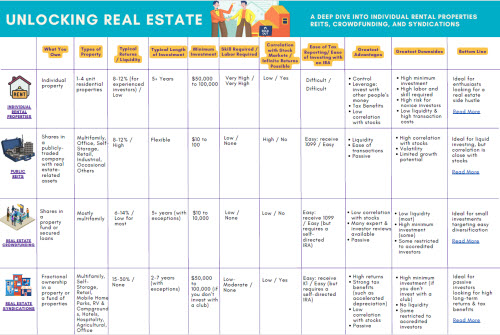
If you invest in real estate syndications rather than owning properties directly, there’s a simpler approach we sometimes call a “lazy 1031.”
When a syndication sells, you’ll typically owe capital gains and depreciation recapture on your share of the profits. But if you reinvest in a new syndication in the same calendar year, the depreciation from that new investment can offset the gains from the one that sold.
It’s not a formal 1031 exchange. There are no strict 45-day identification periods or qualified intermediaries. You just need to keep investing in new deals and the depreciation benefits keep flowing.
This is one of the reasons I like passive real estate investing. The tax strategy is simpler, and the depreciation benefits can be significant without any of the hands-on work.
3. Hold Until You Die (Seriously)
This sounds morbid but it’s the ultimate real estate tax strategy – hold your properties until death.
When you pass away, your heirs receive a “stepped-up basis.” The property’s basis resets to its current market value at the time of death. All that accumulated depreciation? Gone. Capital gains? Gone. Your heirs can sell immediately and owe nothing.
This is why a lot of wealthy families hold real estate across generations. They’re passing down decades of tax-deferred gains with a clean slate.
(article continues below)
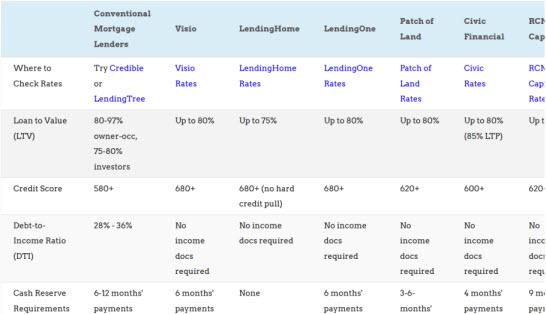 What short-term fix-and-flip loan options are available nowadays?
How about long-term rental property loans?
We compare several buy-and-rehab lenders and several long-term landlord loans on LTV, interest rates, closing costs, income requirements and more.
Why This Matters Before You Start
If you’re just getting into real estate investing, this might feel like a lot. But understanding the tax implications upfront changes how you approach every investment.
It affects what you buy, how long you hold, and how you exit. It affects whether you invest actively (buying properties yourself) or passively (investing in syndications where operators handle the complexity). It affects how you think about building a portfolio over decades versus flipping properties for quick profits.
The investors who build real wealth in real estate aren’t just good at finding deals. They’re good at structuring their investments to minimize the tax drag along the way.
The Bottom Line
Real estate offers some of the best tax advantages of any asset class. Depreciation can shelter your income while you hold. 1031 exchanges can defer your taxes when you sell. And if you hold long enough, you can pass properties to your heirs tax-free.
But if you don’t understand these tools, you can easily get crushed by a tax bill you didn’t see coming.
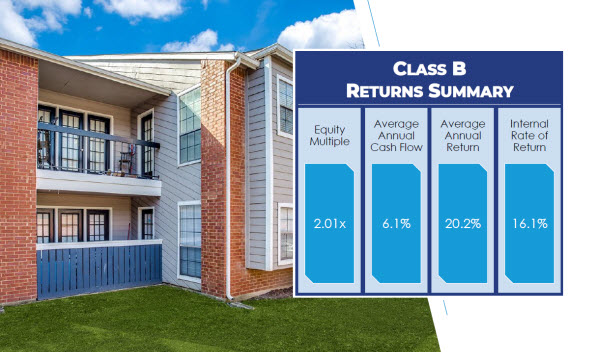
Take the depreciation, plan your exits and reinvest strategically. And if you’re investing passively in syndications, make sure you understand how depreciation flows through to your tax returns.
This is one of those areas where spending an hour with a CPA who understands real estate can save you tens of thousands of dollars. It’s worth the investment.
We talk about tax strategy regularly in the Co-Investing Club, especially when vetting deals where depreciation benefits are a key part of the return profile. If you’re exploring passive real estate and want to understand how the numbers actually work, it’s a good place to start.
About the Author

G. Brian Davis is a real estate investor and cofounder of SparkRental who spends 10 months of the year in South America. His mission: to help 5,000 people reach financial independence with passive income from real estate. If you want to be one of them, join Brian and Deni for a free class on How to Earn 15-25% on Fractional Real Estate Investments.
Connect with us on social!