The Short Version:
-
-
Real estate spreads vs. corporate credit are back to 20-year historical norms after 20-25% repricing from 2021 peak
-
2021 pricing was the anomaly (free money, 3% rates, ZIRP), not 2026 pricing — current valuations are normal
-
Institutional investors (Morgan Stanley, Apollo) are actively deploying into multifamily, senior living, and industrial
-
“Waiting for rates to drop” misses the point — entry pricing matters more than interest rates, and today’s pricing is the opportunity
-

If you’ve been sitting on the sidelines waiting for real estate to “get better,” I’ve got news for you.
It already did.
Real estate valuations have reset 20-25% from their 2021 peak. Spreads relative to corporate credit are back to historical norms. The market didn’t collapse, it simply repriced. And most investors are still treating 2026 like it’s 2023.
Here’s what actually happened, what it means for passive real estate investors, and why the window you’re waiting for is already open.
What Does “Spreads Normalized” Actually Mean?
Let me translate the finance jargon into plain English.
A “spread” is the return difference between two investments. When institutional investors compare real estate to corporate bonds, they’re asking: how much extra return do I get for taking real estate risk instead of bond risk?
From 2020-2021, real estate spreads got compressed. Translation: prices got so high that the expected returns barely exceeded what you could earn from safer corporate bonds. That’s what happens when everyone piles into the same asset class at once.
Then 2022 hit. Interest rates spiked. Suddenly the math changed overnight.
Properties that penciled at 3% interest rates looked terrible at 7% rates. Buyers disappeared. Sellers refused to accept the new reality. Transaction volume collapsed because nobody could agree on what anything was worth.
That’s the bid-ask gap everyone’s been talking about for three years.
But here’s what changed in late 2025 and into 2026: spreads normalized. Real estate yields relative to corporate credit are back in line with 20-year historical averages. The market found equilibrium.
You know what that means? The repricing is done. We’re not waiting for the crash to end… we’re in the stabilization phase.
Why 2021 Pricing Was the Anomaly (Not 2026 Pricing)
I need you to understand something critical: 2021 wasn’t normal.
Free money wasn’t normal. 3% mortgage rates weren’t normal. Institutional investors buying single-family homes sight unseen at 15% over asking wasn’t normal.
What we’re seeing in 2026? This is normal.
Cap rates in the 5-6% range for quality multifamily assets? Normal. Debt at 6-7% for long-term fixed financing? Historically average. Properties trading at valuations that actually make sense relative to their cash flow? That’s how real estate is supposed to work.
The mistake most investors make is anchoring to 2021 as the baseline. They look at today’s pricing and think everything’s “down.” But down from what? Down from the most overheated, overleveraged, artificially inflated market in modern real estate history.
Real estate didn’t get cheap. It stopped being absurdly expensive.
And that’s actually good news if you know how to read it.
The 20-25% Repricing Created the Opportunity
Here’s where this gets interesting for passive investors.
Commercial real estate values dropped 20-25% from peak in most major markets. Office got hit harder. Some sectors like industrial and multifamily in supply-heavy markets saw bigger corrections. But the average was a 20-25% haircut.
That repricing did three things:
First, it flushed out the tourists. The investors who bought in 2021 with maximum leverage and 2-year bridge loans? A lot of them are gone. The operators who survived the last three years are the ones with conservative underwriting, longer-term debt, and actual operating experience.
Second, it reset return expectations. At 2021 pricing, sponsors were projecting 12-15% IRRs and somehow keeping a straight face. Today’s deals are underwritten at 14-18% returns… and those numbers are actually achievable because the basis is 25% lower.
Third, it created motivated sellers. Not distressed fire sales (though some of those exist too), but rational sellers who bought in 2019-2020, have achieved solid returns, and see the writing on the wall for refinancing in 2026-2027. They’re selling at fair pricing because fair pricing is still profitable for them.
You know what all three of those things add up to? Better deal quality, better operator quality, and better entry pricing than we’ve seen in five years.
What Institutional Investors Are Doing Right Now
Let me show you what the smart money is actually doing while retail investors are still paralyzed by fear.
Morgan Stanley Real Estate Investing is actively deploying capital into senior living, multifamily, and select industrial assets. Apollo is calling 2026 the entry point after a three-year repricing cycle. These aren’t speculative funds… these are institutions managing tens of billions in real estate.
They’re not waiting for a “bottom” because they understand there isn’t one. Markets don’t bottom and then flash a green light. They stabilize gradually, and by the time it’s “obvious” that things are good again, pricing has already moved.
Here’s what they’re prioritizing in 2026:
Properties in markets with supply-demand imbalances (limited new construction, strong population growth). Sponsors who survived the 2022-2024 stress test without blowing up deals. Long-term fixed-rate debt that removes refinance risk for 7-10 years. Assets that repriced 20%+ from peak and are now trading at replacement cost or below.
Sound familiar? It should. That’s the exact filter we use every month in the Co-Investing Club when we’re vetting deals.
Institutional capital doesn’t wait for perfect clarity. They move when the risk-reward tilts in their favor. And right now, with spreads normalized and pricing reset, the math works again.
Why “Waiting for Rates to Drop More” Misses the Point
I keep hearing the same thing: “I’m waiting for interest rates to come down before I invest.”
Let me be blunt… you’re optimizing for the wrong variable.
Yes, the Fed cut rates 75 basis points in 2025. Yes, they’ll probably cut more in 2026. But you know what else happens when rates drop? Property values go up. Sellers get more confident. Competition increases. The deals get picked over faster.
You’re not racing against interest rates. You’re racing against the return of confidence.
Right now, in early 2026, you’ve got a brief window where:
- Pricing has reset 20-25% from peak
- Spreads are back to historical norms (meaning yields are attractive relative to risk)
- Motivated sellers exist who aren’t distressed but aren’t greedy either
- Quality operators who survived the downturn are actively buying
That window doesn’t stay open. It’s already closing.
When rates drop another 100 basis points and transaction volume surges, you know what won’t be available anymore? The deals you’re looking at today at today’s pricing.
I’m not saying rates don’t matter. They do. But entry pricing matters more. And entry pricing is better right now than it’s been in years.
The Difference Between Recovery and Repricing
Here’s the mental model most investors get wrong.
They think markets crash and then recover. Like there’s this V-shaped chart where everything goes down and then everything goes back up to where it was.
Real estate doesn’t work like that.
Real estate reprices and then stabilizes. The 2021 peak isn’t coming back because that peak was based on fundamentals (3% debt, infinite liquidity, ZIRP) that don’t exist anymore and won’t exist again.
What’s happening in 2026 isn’t a recovery back to 2021 pricing. It’s stabilization at new, sustainable levels. And those sustainable levels still generate excellent returns… they’re just based on actual cash flow instead of appreciation speculation.
Let me give you a concrete example. A Class A multifamily property in Austin that traded at a 4.2% cap rate in 2021 might trade at a 5.8% cap rate today. That’s not a sign the market is broken. That’s a sign the market is functioning correctly again.
The property still cash flows. The operator still makes money. The investors still earn returns. The math just makes sense now in a way it didn’t at 4.2%.
You’re not buying the dip. You’re buying at fair value. And fair value in real estate has always been where the real money gets made.
(article continues below)
Real estate investments? Awesome.
Being a landlord? Less fun.
Learn how to earn 15%+ on passive real estate investments in our free video course.

What This Means for Passive Real Estate Investors in 2026
So what do you actually do with this information?
First, stop anchoring to 2021. Those prices are gone. Those returns are gone. That’s fine. The returns available today at today’s pricing are better anyway because they’re based on reality.
Second, focus on operators who survived 2022-2024 without imploding. If a sponsor made it through the last three years without missing distributions, without defaulting on debt, without having to inject massive amounts of rescue capital… that sponsor just passed the stress test. Those are the people you want to invest with in 2026.
Third, prioritize deals with long-term fixed debt. I cannot overstate this enough. Bridge loans and variable-rate debt killed more deals in the last three years than bad markets did. A mediocre deal with 10-year fixed debt at 6.5% will outperform a great deal with a 3-year bridge loan at 7% floating.
Fourth, look for deals in markets where new supply is constrained. The multifamily construction pipeline dropped 40-50% in major Sunbelt markets. That supply crunch creates pricing power for existing assets. You want to own the properties that benefit from that dynamic.
And fifth, don’t wait for perfect clarity. The best opportunities don’t come with certainty. They come when the math makes sense but the headlines still sound scary.
Right now, spreads tell us the math makes sense. The headlines still sound scary. That’s the window.
(article continues below)
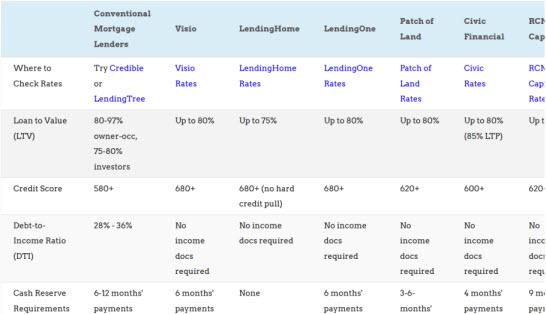 What short-term fix-and-flip loan options are available nowadays?
How about long-term rental property loans?
We compare several buy-and-rehab lenders and several long-term landlord loans on LTV, interest rates, closing costs, income requirements and more.
The Bottom Line
Real estate spreads normalized. That’s not an opinion, it’s observable data from institutional credit markets.
What that means: the repricing is done, the stabilization has started, and the risk-reward for quality deals is back to levels we haven’t seen since 2018-2019.
You can keep waiting for rates to drop, for headlines to improve, for some magical signal that it’s “safe” to invest again. Or you can do what institutional investors are doing right now… deploy capital at reset pricing with quality operators who survived the stress test.
We vet a new passive real estate investment every month in the Co-Investing Club. Multifamily, senior housing, industrial… deals with experienced sponsors, conservative debt structures, and return targets in the 14-18% range. Members invest with as little as $5,000 instead of the typical $50K-$100K minimums.
If you’ve been sitting on the sidelines waiting for real estate to “get better,” it already did. You just weren’t looking at the right metric.
Spreads don’t lie. And right now, they’re telling us exactly what institutional money already knows: 2026 is the year to deploy capital, not the year to keep waiting.
About the Author

G. Brian Davis is a real estate investor and cofounder of SparkRental who spends 10 months of the year in South America. His mission: to help 5,000 people reach financial independence with passive income from real estate. If you want to be one of them, join Brian and Deni for a free class on How to Earn 15-25% on Fractional Real Estate Investments.
Connect with us on social!