The Short Version:
-
- Saving preserves capital. Investing grows it. Confusing the two can cost you decades of wealth-building potential.
- A savings account earning 4% while inflation runs at 3.5% means you’re barely treading water — and most years, you’re actually falling behind.
- The risk of not investing is just as real as the risk of investing. It’s just less visible.
- Every year you wait is a year of compounding you’ll never get back.
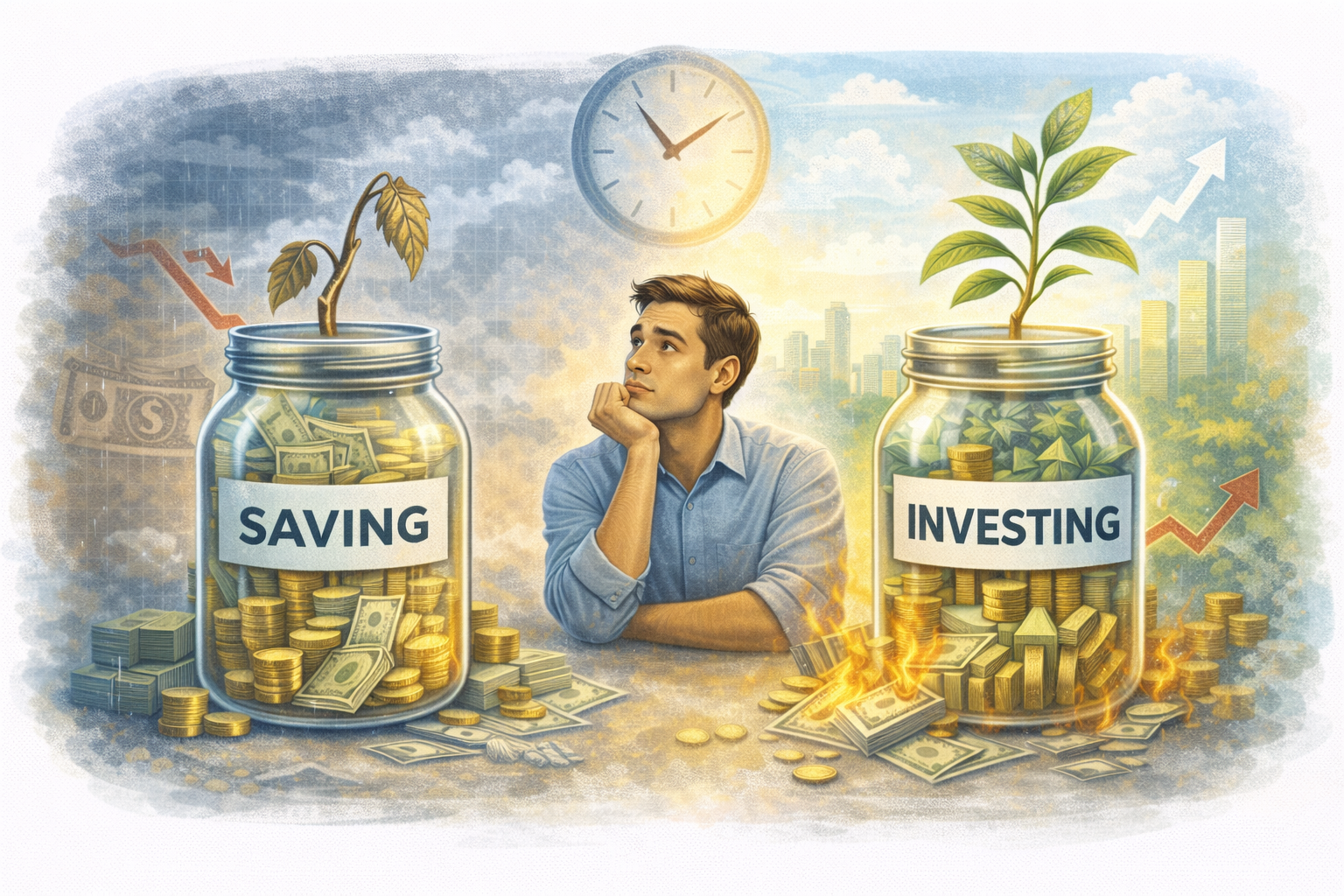
A lot of people think they’re investing when they’re really just saving. They’ve got money in a high-yield savings account earning 4%, maybe some cash sitting in a money market fund, and they feel like they’re being responsible with their finances.
Saving is holding onto money. Investing is putting money to work. One preserves capital. The other grows it. Confusing the two can cost you decades of wealth building potential.
What Saving Actually Does
Saving is essential. Everyone needs an emergency fund. Everyone needs cash reserves for short-term expenses. Having 3-6 months of living expenses sitting somewhere safe and accessible is basic financial hygiene.
But saving doesn’t grow your wealth. At best, it maintains your purchasing power. More often, it slowly erodes it.
Let’s say you’ve got $50,000 in a savings account earning 4% interest. But if inflation is running at 3.5%, your real return is 0.5% which means you’re barely treading water.
And that’s a “good” scenario. For most of the last two decades, savings account rates were closer to 0.5% while inflation averaged 2-3%. Savers were LOSING purchasing power every single year without realizing it.
That’s the cost of saving instead of investing. Your balance goes up slightly, so it feels like progress. But the things you want to buy with that money (a house, retirement, financial freedom) keep getting more expensive faster than your savings grow.
Robert Kiyosaki puts it bluntly: “Savers are losers.” It sounds harsh, but the math backs him up. If you’re ONLY saving… you’re falling behind.
What Investing Actually Does
Investing is fundamentally different. When you invest, you’re buying assets that have the potential to grow in value or generate income over time.
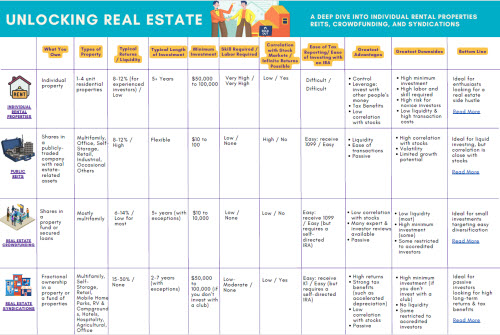
Stocks represent ownership in companies that (ideally) become more valuable as they grow earnings. Bonds pay interest in exchange for lending your capital. Real estate generates rental income and appreciates over time. Each of these puts your money to work in ways that a savings account simply can’t.
The historical numbers tell the story. The S&P 500 has returned roughly 10% annually over the long term. Real estate has delivered similar returns when you factor in cash flow, appreciation, and tax benefits. Compare that to the 0.5-4% you might get from a savings account, and the gap becomes obvious.
But the real magic lies in compounding.
Albert Einstein allegedly called compound interest the 8th wonder of the world. And for good reason…
$50,000 invested at 8% annually…
In 10 years, it becomes roughly $108,000
In 20 years, it’s $233,000
In 30 years, it’s over $500,000
That same $50,000 in a savings account at 2% is only $91,000 after 30 years.
This is why the distinction between saving and investing matters more than just semantics. It’s the difference between retiring comfortably and working longer than you wanted to.
Why People Save When They Should Be Investing
If investing is so obviously better, why do so many people stick with saving?
Fear is the biggest reason. Investing involves risk. Savings accounts feel safe. You can see your balance sitting there, stable and predictable. The stock market, on the other hand, can drop 30% in a bad year. Real estate deals can go sideways. The possibility of loss keeps a lot of people on the sidelines.
But here’s what they’re not accounting for: the risk of not investing. Inflation is guaranteed. Every year, your money buys you a little less. The stock market might drop 30% temporarily, but over any 20-year period in history, it’s been positive. The risk of staying in cash is just as real as the risk of investing (it’s just less visible.)
There’s also the knowledge gap. Investing feels complicated. Stocks, bonds, mutual funds, ETFs, real estate syndications, private equity… it’s a lot of jargon. People don’t want to feel stupid, so they stick with what they understand – savings accounts.
And honestly, I get it. I felt the same way when I started. The fear of looking like an amateur kept me on the sidelines longer than it should have.
But waiting has a cost too.
(article continues below)
Real estate investments? Awesome.
Being a landlord? Less fun.
Learn how to earn 15%+ on passive real estate investments in our free video course.

The Real Risk Is Doing Nothing
Every year you’re not invested is a year of compounding you’ll never get back.
Let’s say you’re 35 and you have $30,000 to invest. If you invest it today and earn 8% annually, by the time you’re 55, you’ll have roughly $140,000. If you wait five years to invest that same $30,000, you’ll only have about $95,000 by age 55.
Same money and same return but a $45,000 lost just from waiting five years.
This is the cost of inaction which doesn’t show up on any statement. There’s no fee or penalty. But it’s real and it compounds in the wrong direction.
The earlier you shift from saving to investing, the more time compounding has to work in your favor. Warren Buffett made 99% of his wealth after age 50, but only because he started investing at age 11.
Finding the Right Balance
This isn’t an argument against saving entirely. You need savings. Cash reserves for emergencies are non-negotiable. Money you’ll need in the next one to two years should stay liquid and accessible.
But beyond that, your money should be working. Sitting in a savings account isn’t a long-term strategy.
The exact mix depends on your age, your income stability, your risk tolerance, your goals. But a good rule of thumb – once you’ve got your emergency fund and short-term needs covered… the rest should be invested in assets that can actually grow.
(article continues below)
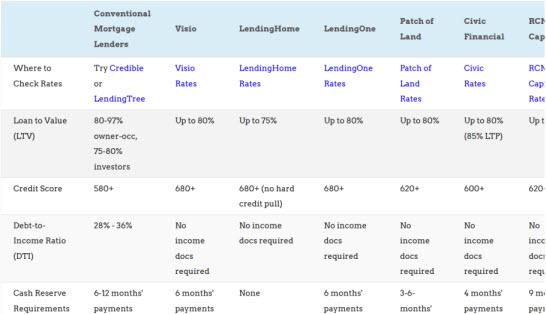 What short-term fix-and-flip loan options are available nowadays?
How about long-term rental property loans?
We compare several buy-and-rehab lenders and several long-term landlord loans on LTV, interest rates, closing costs, income requirements and more.
Where I Put My Money to Work
I’ve tried a lot of different approaches over the years. Stocks, real estate, alternative investments. What I keep coming back to is passive real estate.
The returns have been competitive with (and often better than) stocks. The income is more predictable, the volatility is lower and there are tax advantages that don’t exist in other asset classes.
Most importantly, it’s genuinely passive. I’m not managing properties or dealing with tenants. I invest alongside experienced operators who handle everything.
Real estate isn’t the only way to invest. But for people who want income-producing assets backed by something tangible… it’s hard to beat.
The Bottom Line
Saving and investing aren’t the same thing. Saving protects what you have while investing grows it.
The goal is simply to put your money in a position where it can actually compound over time. Start with your emergency fund, then move everything else into assets that grow.
That’s exactly what we do in the Co-Investing Club. Every month, we vet a new passive real estate deal together and any member who likes the opportunity can invest alongside the group for as little as $5,000. If you’re looking for a place to start putting your money to work, it’s worth checking out.
The best time to start investing was years ago. The second best time is today.
About the Author

G. Brian Davis is a real estate investor and cofounder of SparkRental who spends 10 months of the year in South America. His mission: to help 5,000 people reach financial independence with passive income from real estate. If you want to be one of them, join Brian and Deni for a free class on How to Earn 15-25% on Fractional Real Estate Investments.
Connect with us on social!