The Short Version:
-
-
110,000+ single-family rentals under construction (53.5% spike) — led by Texas (21.8K units), Arizona and Florida (~14K each)
-
Build-to-rent is NOT Wall Street buying existing homes — it’s new construction designed for institutional rental ownership from day one
-
Cost to own vs. rent spread is ~$1,800/month (roughly 2x rent) — affordability collapse is structural, not cyclical
-
Policy uncertainty (7-year sell requirement) may slow future development but doesn’t affect current 110K+ unit pipeline
-
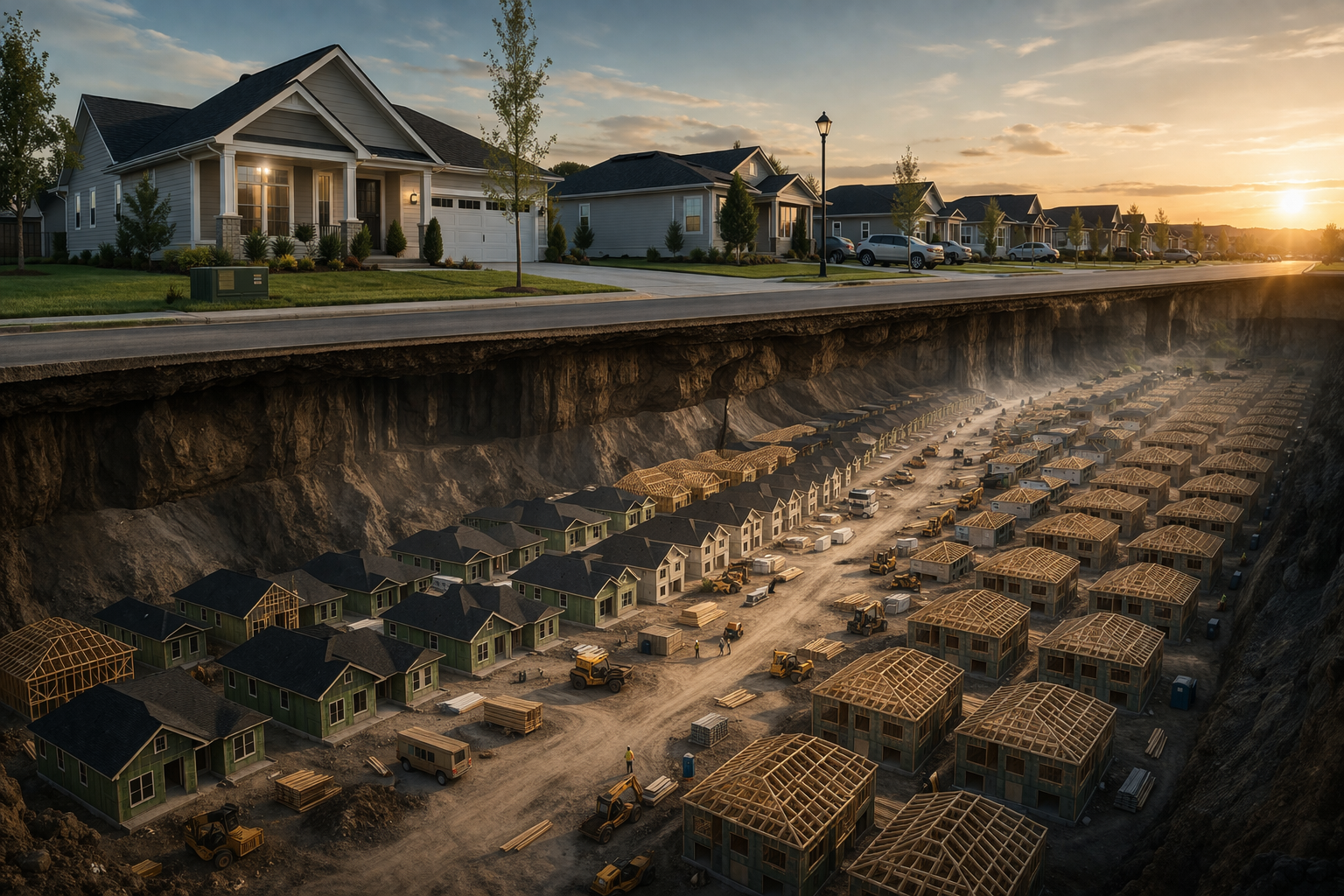
Over 110,000 single-family rental homes are under construction right now across the United States.
That’s a 53.5% spike in build-to-rent inventory from last year. Not a gradual increase. Not a modest uptick. A spike.
And most passive real estate investors have no idea this is happening… which means they’re missing the structural shift that institutional money figured out three years ago.
Here’s what’s driving this boom, why it’s not slowing down despite policy headwinds, and how passive investors can access this market without becoming landlords.
What Build-to-Rent Actually Means (And Why It’s Different)
Let me clear up some confusion right off the bat.
Build-to-rent (BTR) is not the same thing as buying an existing house and renting it out. It’s not Wall Street buying up homes in your neighborhood and pricing out first-time buyers.
Build-to-rent means developers are constructing brand new single-family homes specifically designed to be owned and operated as rental properties from day one. These aren’t homes hitting the MLS. They’re rental communities — typically 200-300 units built on a single tract of land, often with shared amenities like pools, dog parks, clubhouses.
Think of it as horizontal multifamily. Same institutional ownership model, same professional property management, same economies of scale… but instead of a 200-unit apartment building, it’s 200 single-family cottages or townhomes spread across a planned community.
The homes themselves are smaller than typical for-sale single-family construction (usually 1,200-1,800 square feet vs. 2,200+ for buyer homes). They’re built efficiently, often with identical or near-identical floorplans. And they’re clustered together in a way that makes management practical at scale.
This is what’s booming right now. And the numbers are staggering.
The Numbers Behind the 110,000-Unit Pipeline
Let’s break down what’s actually under construction as of early 2026.
Texas leads with 21,800 units in development. Arizona and Florida each have nearly 14,000 units. North Carolina and Georgia round out the top five with over 12,000 and 10,000 units respectively.
At the metro level, Phoenix is king with 13,100 single-family rentals in the pipeline. That’s more than most entire states. Dallas follows with 8,470 units.
But here’s what’s wild: the percentage increases in some states are even more dramatic than the raw numbers.
North Carolina is seeing a 152% jump in single-family rental inventory. Nebraska is up 255%. These aren’t markets that traditionally had large-scale rental development. They’re being unlocked because the BTR model scales differently than scattered-site investing.
When all these units hit the market over the next 12-18 months, total build-to-rent inventory nationwide will increase by more than 50%. In some markets, the rental supply will more than double.
And this isn’t speculative construction. These projects pencil at current market rents. The demand is already there.
Why Home Affordability Collapse Drives BTR Demand
Here’s the fundamental economic reality driving this boom: the cost to own a home versus the cost to rent is at a historic spread.
As of Q1 2026, the monthly cost premium to buy versus rent is around $1,800. That’s roughly double the cost to rent in many markets.
Let me put that in concrete terms. A household earning $100,000 a year can comfortably afford a $2,000/month rent payment for a nice single-family home with a yard and garage. That same household cannot afford a $3,800/month mortgage payment plus property taxes, insurance, and maintenance on the equivalent house.
The math isn’t even close.
30-year mortgage rates, even after recent declines, are still in the 6% range. Median home prices are hovering near all-time highs. Down payment requirements haven’t changed. First-time buyers are getting priced out systematically.
Meanwhile, renter demographics are shifting. It’s not just people who can’t afford to buy. According to Yardi Matrix, 36% of build-to-rent residents in 2024 identified as “renters by preference,” up from 27% in 2023.
These are households that could buy but choose not to. They want the flexibility. They don’t want to manage maintenance. They’re not ready to commit to a specific neighborhood long-term. They value mobility over equity building.
This isn’t temporary. This is a structural shift in how Americans think about housing.
The Policy Chaos (And Why BTR Survives It)
Now here’s where things get messy politically.
In January 2026, President Trump signed an executive order targeting “large institutional investors” buying single-family homes. The stated goal is to combat speculation and protect homeownership opportunities for regular Americans.
The Senate passed the 21st Century ROAD to Housing Act in March — 89 votes in favor, only 10 against. Bipartisan support. The bill bans institutional investors (defined as anyone owning 350+ single-family homes) from buying more homes… with specific exceptions.
One of those exceptions? Build-to-rent.
The legislation explicitly carves out BTR projects from the ban because lawmakers recognize these developments increase housing supply rather than constrain it. You can’t “buy up” a home that wouldn’t exist without the BTR developer building it in the first place.
There’s one catch: the current Senate version requires BTR properties to be sold to individual buyers within seven years, with renters getting right of first refusal.
That provision has 79 industry groups — including property managers, housing advocates, and construction firms — pushing back hard. They argue it “would effectively eliminate the production of Build-to-Rent housing” because it kills the long-term return model that makes institutional investment viable.
Will the seven-year sell requirement survive reconciliation? Unknown. The political winds are shifting weekly.
But here’s what I know: even if that provision stays in, it grandfathers all projects already under construction and all projects started before the final bill is signed. That’s 110,000+ units protected regardless of what happens legislatively.
And if the provision gets stripped out (which many industry insiders expect), BTR development accelerates even faster.
Why Institutional Capital Keeps Flowing Into BTR
Let’s talk about why the smart money is piling into this sector despite the policy uncertainty.
First, operational efficiency. Managing 250 single-family homes in a planned community with one property management team is exponentially easier than managing 250 scattered homes across a metro area. Lower vacancy costs, lower turnover costs, lower maintenance coordination costs.
Second, rent premiums. Build-to-rent properties command 10-15% higher rents than comparable multifamily units because renters pay more for single-family living (yard, garage, no shared walls, pet-friendly).
Third, demographic tailwinds. Millennials with young kids want single-family homes but can’t afford to buy. Gen Z entering the workforce values flexibility over ownership. Both cohorts are growing the renter base.
Fourth, development costs pencil. In Sunbelt markets where land is still relatively cheap and construction costs are manageable, BTR projects can hit 6-7% stabilized yields even after the recent interest rate increases.
Fifth, lower construction risk than multifamily. Horizontal development doesn’t have the same permitting nightmares as vertical construction. Local opposition is lower because BTR looks like normal suburban housing, not apartment complexes.
Firms like Middleburg, NexMetro, Quinn Residences… these aren’t Mom and Pop landlords. They’re institutional operators with billions in assets under management, vertically integrated construction arms, and long-term hold strategies.
And they’re not slowing down. Despite headlines about policy risk and cooling rent growth, BTR fundamentals remain strong.
The Returns Profile (And What Passive Investors Should Know)
So what do BTR investments actually return?
Stabilized cap rates for quality BTR assets in strong markets are running in the 5.5-6.5% range as of Q1 2026. That’s compressed from 7%+ you could get in 2023, which tells you institutional demand is strong.
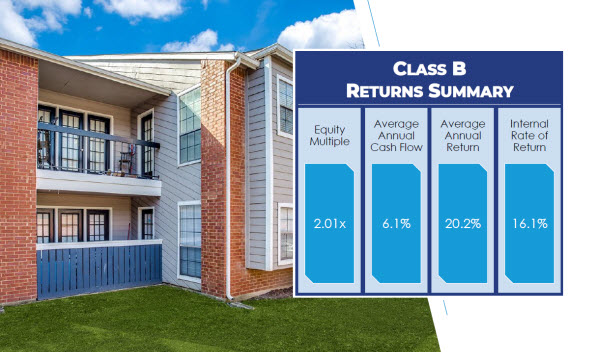
Cash-on-cash returns for investors in BTR syndications typically project in the 6-8% range during the hold period. IRRs (internal rate of return) usually target 12-16% when you include appreciation and exit proceeds.
Not blockbuster returns. But solid, predictable, inflation-hedged cash flow with demographic tailwinds behind it.
Here’s what matters more than the raw return numbers: risk-adjusted returns. BTR has proven more resilient than traditional multifamily in recent market volatility.
Why? Lower vacancy rates (people don’t move out of single-family rentals as frequently as apartments). Higher quality tenant base (household incomes in BTR average 20-30% higher than multifamily). Better rent retention during downturns (families prioritize keeping their kids in the same school district).
During the 2022-2024 interest rate shock that killed a lot of multifamily deals, BTR assets held up remarkably well. Rent growth slowed but stayed positive. Occupancy remained in the mid-to-high 90s. Refinancing didn’t blow up projects because most sponsors had locked in longer-term debt.
That’s the kind of stability passive investors should pay attention to.
How to Access BTR as a Passive Investor
Here’s the practical question: if you’re a passive investor with $50K-$100K to deploy, how do you actually get into build-to-rent?
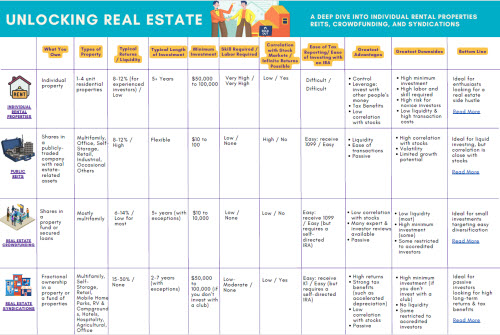
Option one: BTR-focused REITs. Companies like Invitation Homes and American Homes 4 Rent own massive portfolios of single-family rentals (though much of it is scattered-site, not pure BTR). You can buy shares on the stock market. Liquid, easy, diversified… but you’re paying management fees and you’re exposed to public market volatility that has nothing to do with the underlying real estate fundamentals.
Option two: Private BTR syndications. Sponsors raise capital from accredited investors to develop or acquire BTR communities. Typical minimums are $50K-$100K. Hold periods are 5-7 years. Returns target mid-teens IRRs. You get the tax benefits (depreciation), the direct exposure to the asset, and alignment with the sponsor… but you need significant capital and you’re illiquid for the duration.
Option three: Join an investment club that vets BTR deals and goes in collectively with lower per-person minimums. This is what we do in the Co-Investing Club — we review passive real estate investments every month, including BTR projects, and members can participate starting at $5,000 instead of $50K+.
The advantage of the club model: you get diversification across multiple BTR projects in different markets without needing six figures per deal. You get group vetting so you’re not evaluating sponsors solo. And you get deal flow — BTR opportunities crossing your desk regularly instead of you having to hunt for them.
Whichever route you take, here’s what to look for in a quality BTR investment:
Sponsor experience developing and operating BTR communities (not just scattered-site). Markets with strong job growth, population influx, and limited new for-sale housing supply. Conservative debt structures (preferably 7-10 year fixed, not bridge loans). Pro forma rents that are achievable based on current market comps, not aggressive projections. Exit assumptions that don’t rely on cap rate compression or massive appreciation.
The sponsors who survived the 2022-2024 stress test in multifamily are the ones you want running your BTR investments. Conservative underwriting beats aggressive return projections every single time.
(article continues below)
Real estate investments? Awesome.
Being a landlord? Less fun.
Learn how to earn 15%+ on passive real estate investments in our free video course.

What Happens When 110,000 Units Hit the Market
Let’s talk about supply dynamics for a second.
110,000 units coming online over the next 12-18 months sounds like a lot. And it is. But context matters.
The U.S. has about 800,000 fewer single-family homes available for rent compared to a decade ago. Some of that is investors selling to homebuyers. Some is conversion back to owner-occupied. Either way, there’s a supply deficit.
BTR is filling that gap. Even with 110,000 new units, we’re not flooding the market. We’re catching up to demand.
Will rent growth slow in markets with heavy BTR concentration (Phoenix, Dallas, Austin)? Probably. We’re already seeing that play out — single-family rent growth in those metros was 0.9% year-over-year in late 2025, down from 3% the prior year.
But slowing rent growth isn’t the same as negative rent growth. And in a market where home affordability keeps deteriorating, the renter base keeps expanding.
The risk isn’t oversupply. The risk is building in the wrong submarkets or underwriting to rents that don’t materialize. That’s a sponsor quality issue, not a sector issue.
Good BTR sponsors are targeting submarkets with strong school districts, proximity to employment centers, and limited competing supply. They’re building smaller, more efficient homes that hit price points renters can actually afford. They’re focused on operational efficiency and long-term holds, not quick flips.
Those projects will perform regardless of whether Phoenix adds 5,000 or 10,000 BTR units this year.
(article continues below)
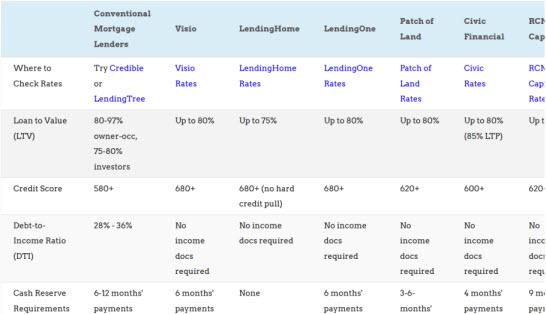 What short-term fix-and-flip loan options are available nowadays?
How about long-term rental property loans?
We compare several buy-and-rehab lenders and several long-term landlord loans on LTV, interest rates, closing costs, income requirements and more.
The Bottom Line
Single-family rental construction just spiked 53.5%. Over 110,000 units are in the pipeline. Texas, Arizona, Florida, and North Carolina are leading the charge.
This isn’t a temporary trend. It’s a structural response to the permanent affordability gap between owning and renting. Institutional capital sees it. Developers are building it. Renters are demanding it.
Policy uncertainty around the seven-year sell requirement could slow future development, but it won’t kill the projects already underway. And there’s a decent chance that provision gets stripped out entirely during reconciliation.
For passive investors, BTR offers a compelling risk-return profile: mid-teens IRRs, steady cash flow, demographic tailwinds, and operational advantages over both scattered-site rentals and traditional multifamily.
The challenge is access. Most BTR syndications require $50K-$100K minimums, which locks out investors who want to diversify across multiple deals or markets.
Every month in the Co-Investing Club, we evaluate passive real estate investments — including BTR projects — and members go in collectively starting at $5,000 per deal. We ask the hard questions about sponsor experience, market fundamentals, debt structures, and exit assumptions. We pass on deals that don’t meet the bar. And we move fast on the ones that do.
The BTR boom is real. The 110,000-unit pipeline is real. The institutional capital flowing into the sector is real.
You can sit on the sidelines and watch it happen, or you can get positioned alongside the institutional investors who saw this shift coming years ago.
The window to deploy capital into quality BTR deals at current pricing won’t stay open forever. Supply will eventually catch up to demand. Rent growth will normalize. Cap rates will compress as more investors pile in.
Right now, in Q2 2026, you’ve got the supply surge creating opportunity, policy uncertainty creating hesitation, and fundamentals that still pencil for patient investors with smart sponsors.
That’s the window.
About the Author

G. Brian Davis is a real estate investor and cofounder of SparkRental who spends 10 months of the year in South America. His mission: to help 5,000 people reach financial independence with passive income from real estate. If you want to be one of them, join Brian and Deni for a free class on How to Earn 15-25% on Fractional Real Estate Investments.
Connect with us on social!