
The Short Version:
-
- I bought about a dozen rental properties in the mid-2000s. I overleveraged, bought in rough neighborhoods, and had no idea how to actually forecast cash flow. I made every rookie mistake in the book.
- When 2008 hit, I got crushed from both sides… underwater properties and a job loss. It took years to recover.
- Even in normal times, landlording was exhausting. Tenant calls, bad property managers, mediocre returns after real expenses. There was nothing passive about it.
- Now I invest in passive real estate deals where operators handle everything. Better returns, zero headaches, and I actually get my time back.
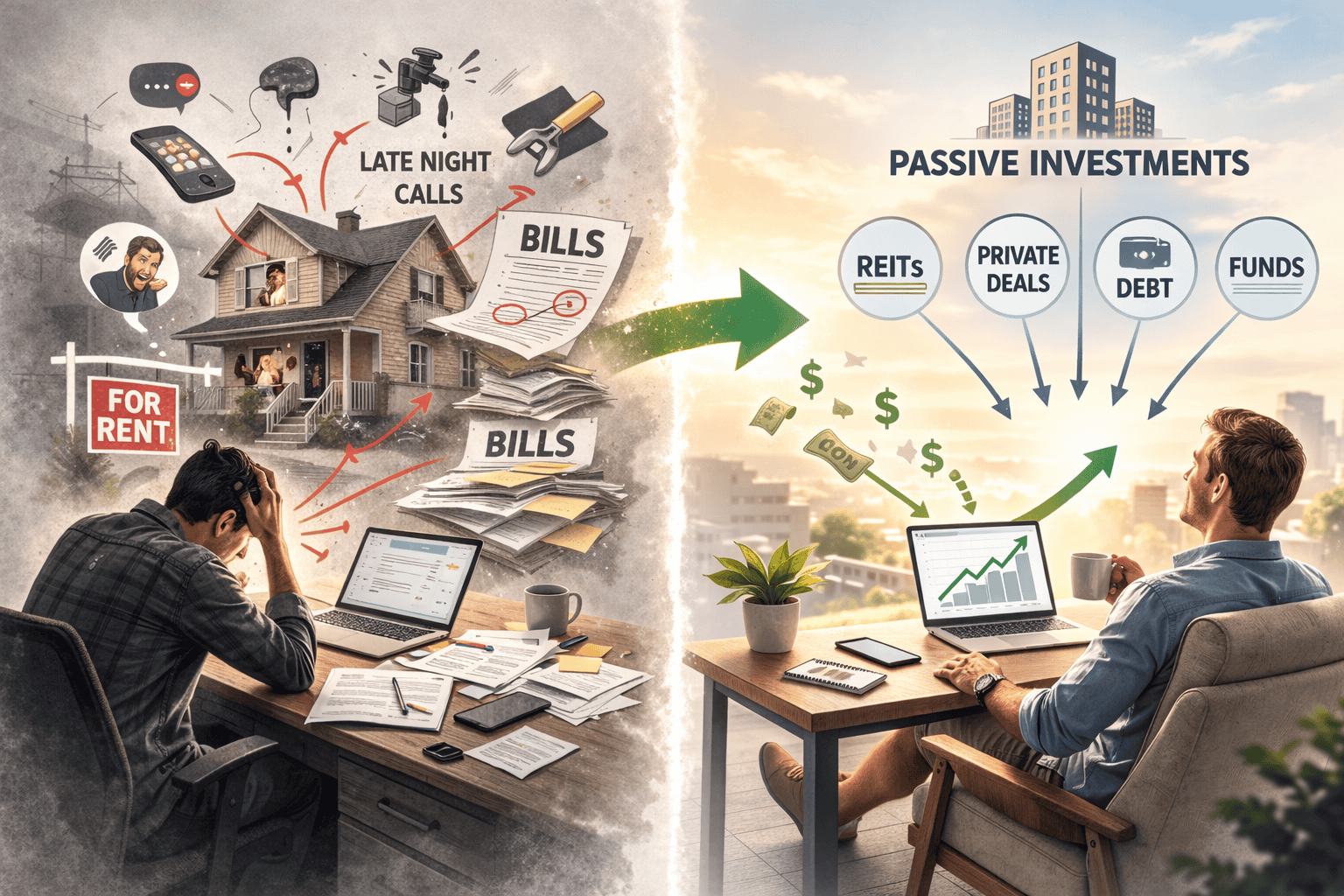
I used to be a landlord. I owned rental properties, dealt with tenants, managed contractors, and did all the things you’re supposed to do as a “real estate investor.”
I hated it.
That’s not the story you usually hear. Most real estate content online makes landlording sound like a straightforward path to wealth. Buy a property, rent it out, collect passive income, repeat. Financial freedom in a few simple steps.
The reality was nothing like that. At least not for me.
Here’s what actually happened, why I eventually sold my rentals, and what I do instead now.
How I Got Into Rental Properties
I fell into real estate by accident. After college in 2003, I had no idea what I wanted to do with my life. I ended up interning at a mortgage company, which led to a job in hard money lending. Suddenly I was surrounded by real estate investors, flippers, landlords… people who seemed to be making money hand over fist.
This was the mid-2000s. The market was ripping. Everyone was getting rich in real estate, or so it seemed. I figured if they could do it, so could I.
So I started buying rental properties. I bought about a dozen of them over a few years. I was convinced I was building wealth, building my future, doing the smart thing.
I was 20-something years old, full of confidence, and had no idea what I was doing.
The Mistakes I Made
Looking back, I made every rookie mistake in the book.
I overleveraged. I put as little down as possible on each property, stretched myself thin across multiple deals, and assumed the market would keep going up forever. I had no real cash reserves. No margin for error.
I didn’t know how to forecast cash flow properly. I was running around thinking cash flow was just rent minus the mortgage payment. I had no concept of the 50% rule… the idea that roughly half your rent goes to non-mortgage expenses when you average out vacancies, repairs, maintenance, property management, and everything else that eats into your returns.
I bought in rough neighborhoods because the cap rates looked great on paper. What I didn’t understand was that lower-income rental properties are a niche investment strategy that requires niche expertise. The turnover is higher. The property managers willing to work those areas are often the dregs of the industry. Crime, vandalism, and theft are constant problems. I had air conditioning units ripped apart for the copper inside. I had appliances stolen out of properties. Good tenants would move out because of the neighborhood, leaving me with vacancies and turnover costs.
And I didn’t get a mentor or a coach. I thought I could figure it all out myself. The universe has a way of correcting that kind of hubris.
Then 2008 Happened
When the market crashed, I got hit from both sides.
On the investment side, I had properties that were underwater and bleeding negative cash flow. I couldn’t sell them without bringing money to the closing table. I was stuck with assets I didn’t want and couldn’t afford to keep.
On the income side, I lost my job. The hard money lending business dried up overnight. Nobody was flipping houses anymore. Nobody needed the loans we were making.
It took years to recover. I eventually got a job with an online company serving mom-and-pop landlords, which is how I ended up co-founding SparkRental in 2016. But those years in between were brutal. I paid a lot of tuition to the school of hard knocks.
What Landlording Actually Looked Like
Even setting aside the 2008 disaster, the day-to-day reality of being a landlord was exhausting.
Tenants called at inconvenient times. Things broke constantly. People paid late, or didn’t pay at all. I spent more time chasing rent and coordinating repairs than I ever spent “building wealth.”
Finding good property managers was nearly impossible, especially for the lower-end properties I owned. The professional managers didn’t want to deal with those neighborhoods. The ones who would take them on were often incompetent or dishonest. I cycled through manager after manager, never finding one I could truly trust.
The returns weren’t what I expected either. After accounting for all the real expenses… the vacancies, the repairs, the management fees, the capex… I wasn’t making nearly as much as my napkin math had suggested. Some properties barely broke even. A few lost money consistently.
I was working hard for mediocre returns on an asset class that was supposed to be “passive income.” There was nothing passive about it. It was a second job, and not a particularly enjoyable one.
(article continues below)
Real estate investments? Awesome.
Being a landlord? Less fun.
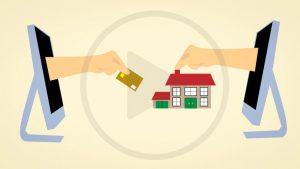
Learn how to earn 15%+ on passive real estate investments in our free video course.

The Shift to Passive Investing
At a certain point, I started asking myself a different question. Instead of “how do I become a better landlord,” I asked “is there a way to get real estate returns without all this headache?”
That’s when I discovered passive real estate investing.
The concept is simple. Instead of buying properties myself and dealing with all the operational headaches, I invest in deals run by experienced operators. These are syndications, private notes, debt funds, equity funds… real estate investments where my only role is to provide capital and collect returns.
The operators find the deals, secure the financing, manage the properties, handle the tenants, and eventually sell. I vet the opportunity upfront, wire my investment, and receive quarterly distributions. That’s it.
No tenant calls. No contractor management. No 2am emergencies. No chasing rent. No property managers to babysit.
The returns have been competitive with (and often better than) what I was earning as a landlord. But the time investment is close to zero. I spend a few hours vetting each deal before I invest, and then I’m done until the distributions start hitting my account.
Why This Works Better For Me
I want to be clear: landlording works for some people. There are investors who genuinely enjoy the hands-on nature of it, who are good at managing properties and tenants, who have built real wealth through direct ownership. I’m not saying it’s a bad strategy universally.
But for busy professionals with demanding careers… people who value their time and don’t want a second job… traditional landlording is often a poor fit. The “passive income” promise doesn’t match the reality.
Passive real estate investing solves that problem. You get exposure to real estate, the returns, the tax benefits, the tangible assets… without the operational burden. Your money works for you instead of you working for your money.
That’s the whole point of investing, isn’t it?
(article continues below)
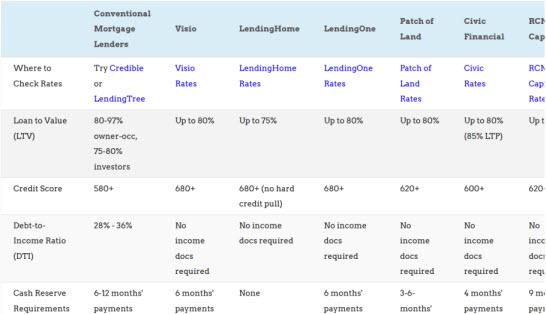 What short-term fix-and-flip loan options are available nowadays?
How about long-term rental property loans?
We compare several buy-and-rehab lenders and several long-term landlord loans on LTV, interest rates, closing costs, income requirements and more.
What I Do Now
These days, I invest in passive real estate deals almost exclusively. Syndications, private notes, land funds, debt funds… we look at all kinds of opportunities through the Co-Investing Club.
Every month, we meet as a group to vet a new deal together. Members ask hard questions, stress-test projections, and evaluate operators. Anyone who likes the opportunity can invest alongside the group for as little as $5,000… far below the $50,000 to $100,000 minimums most of these deals typically require.
I put my own money into most of the deals we do. I’m not pitching investments I wouldn’t make myself.
The club exists because I spent years learning the hard way what doesn’t work. I overleveraged, bought in bad neighborhoods, managed terrible property managers, and lost money I couldn’t afford to lose. Eventually I found a better path, and now I help others skip the painful lessons I had to learn.
The Takeaway
If you’re thinking about getting into real estate, understand that buying rental properties isn’t your only option. It’s the option most people know about, but it’s not necessarily the best one… especially if you value your time.
Passive real estate investing lets you benefit from real estate without becoming a landlord. The returns can be just as strong (or stronger), the tax benefits still apply, and you don’t have to deal with tenants, toilets, or 2am phone calls.
I wish someone had told me this 20 years ago. It would have saved me a lot of money, stress, and wasted time.
But I’m telling you now. Take it from someone who learned the hard way.
About the Author

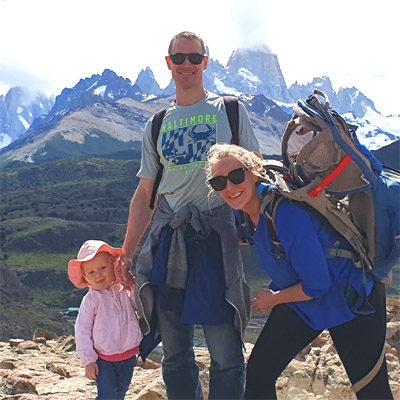
G. Brian Davis is a real estate investor and cofounder of SparkRental who spends 10 months of the year in South America. His mission: to help 5,000 people reach financial independence with passive income from real estate. If you want to be one of them, join Brian and Deni for a free class on How to Earn 15-25% on Fractional Real Estate Investments.
Connect with us on social!














I do a combination of passive and direct.