The Short Version:
-
- Morgan Stanley called 2026 “an inflection point.” Translation: Wall Street already bought, they’re just telling you now.
- Properties trading 20-25% below peak while retail investors wait for “confirmation.”
- Institutional buyers moved in 6 months ago. The headlines are the exit signal, not the entry.
- Forced sellers. Open debt markets. Replacement cost discounts. The window is closing.

Morgan Stanley just declared 2026 “an inflection point” for real estate.
After two years of declining values and a stagnant 2025, they’re calling the bottom. Improved debt markets. Motivated sellers. Properties trading 20-25% below peak values.
Translation: the smart money is already moving.
Here’s what’s actually happening. When major institutional investors publicly announce that conditions are favorable, they’re not giving you a heads-up. They’re explaining where their capital has already gone.
The Pattern You’ve Seen Before
I’ve watched this cycle play out multiple times over 20 years in real estate.
The market crashes. Prices drop. Everyone panics and sells or freezes. Institutional investors quietly start buying distressed assets at massive discounts. The market stabilizes. Headlines eventually declare “recovery is here.” Retail investors finally feel comfortable enough to get back in.
By that point, institutional money has already captured most of the upside.
Right now, we’re somewhere between step three and step four. Morgan Stanley’s December 2025 outlook wasn’t a prediction. It was a report on what’s already happening.
Their researchers noted that motivated sellers are “increasingly facing liquidity needs and maturing debt.” That’s corporate speak for distress. Properties that owners don’t want to sell but have to.
And on the buyer side? “Buyers can acquire assets at 20-25% below peak values, often below replacement cost, while accessing more attractive financing.”
That’s the opportunity. And it won’t last.
What Actually Creates These Windows
The real estate market doesn’t move smoothly. It lurches.
2021-2022 was euphoria. Cheap money. Rising prices. Everyone convinced it would never end.
Then rates spiked. The Fed went from near-zero to over 5% in less than 18 months. Suddenly, properties that penciled at 3% interest rates didn’t work at 6-7%.
Operators who’d loaded up on floating-rate debt got crushed. Deals that looked genius in 2021 turned into disasters by 2023. Syndications went sideways. Investors got burned.
That pain created forced sellers. People who have to sell because their loan is maturing and they can’t refinance at current rates. Or they’re facing capital calls they can’t cover. Or their investors are demanding liquidity.
These aren’t strategic sales. They’re distressed sales. And distressed sellers take whatever bid clears the market.
Morgan Stanley’s team is now reporting that transaction volume increased 16% year-over-year in Q3 2025 in the U.S. That’s institutional capital moving in while headlines still talk about market uncertainty.
Why Retail Investors Always Lag
There’s a psychological barrier most investors never get past.
When the market is crashing, buying feels insane. Everyone’s talking about how bad things are. Prices keep dropping. Your brain screams “wait for the bottom.”
Then prices stabilize. But you still don’t buy because nothing feels different yet. The news is still negative. Sentiment is still cautious.
Only once prices have clearly recovered and everyone agrees conditions are improving do most people finally feel comfortable investing again.
By then, you’re not buying at a discount. You’re buying at fair value or above.
Institutional investors don’t wait for comfort. They wait for opportunity.
When Morgan Stanley’s researchers see properties trading 20-25% below replacement cost, they don’t think “scary market.” They think “margin of safety.”
When they see motivated sellers and improving debt markets, they don’t think “too soon.” They think “window closing.”
The difference is time horizon and capital structure. If you’re managing billions with a 10-year horizon, short-term volatility doesn’t matter. Buying good assets cheap and waiting for fundamentals to normalize is the entire strategy.
Retail investors operate differently. They’re managing their own money. They feel every dollar of loss. They need emotional certainty before they can act.
That gap between institutional buying and retail comfort is where returns get made.
What’s Actually Changing Now
A few specific things are lining up that matter.
- Debt markets have opened back up. Lenders who pulled back hard in 2023-2024 are lending again. Not recklessly. But if you have a solid sponsor and decent asset fundamentals, you can get financing. That’s crucial because most real estate transactions require debt.
- Construction has slowed dramatically. In many markets, it now costs more to build new properties than to buy existing ones. That kills new supply. When supply growth slows while demand holds steady or increases, rents stabilize and valuations recover.
- Maturing debt is creating forced decisions. Morgan Stanley noted that loans maturing between 2025 and 2030 are almost double the volume from the post-2008 cycle. Owners can’t just extend and pretend anymore. They have to refinance at higher rates or sell.
That creates deal flow. And in markets with limited buyers, it creates pricing opportunities.
(article continues below)
Real estate investments? Awesome.
Being a landlord? Less fun.
Learn how to earn 15%+ on passive real estate investments in our free video course.

Where This Shows Up in Practice
I’m seeing this in the deals crossing our desk for the Co-Investing Club.
Six months ago, we were looking at syndications where operators were scrambling. Bad debt structures. Unrealistic projections. Desperate capital raises trying to patch holes in deals that didn’t work anymore.
Now we’re seeing different deals. Experienced operators buying assets from distressed sellers at real discounts. Long-term fixed-rate debt locked in. Conservative underwriting that assumes modest rent growth and normal operations.
These deals aren’t exciting. They’re not promising 20% IRRs. They’re structured around 12-14% returns with strong downside protection.
That’s what recovery looks like before it’s obvious. Steady, boring deals with margin built in.
The operators we work with are deploying capital now because they’ve been through cycles before. They know that when good assets trade at replacement cost or below, you buy. You don’t wait for perfect clarity. You buy when the price compensates you for uncertainty.
The Underlying Principle
Market timing is mostly luck. But market positioning is skill.
You don’t need to pick the exact bottom. You just need to be buying when assets trade below intrinsic value and selling when they trade above it.
Right now, commercial real estate is repricing. Some sectors and markets have overcorrected. Properties are trading at discounts that don’t reflect long-term fundamentals.
That won’t last forever. As debt markets normalize and transaction volume increases, pricing will adjust. The discount to replacement cost will narrow. The motivated sellers will dry up.
When Morgan Stanley publishes research declaring an “inflection point,” they’re not predicting the future. They’re describing the present based on where their money has already moved.
Retail investors read those headlines and think “interesting, maybe I should start paying attention.”
Institutional investors read those headlines and think “we’ve been buying for six months already.”
(article continues below)
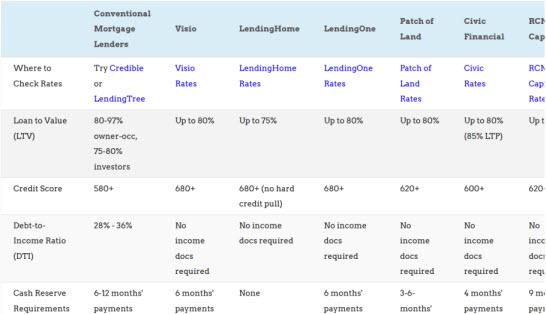 What short-term fix-and-flip loan options are available nowadays?
How about long-term rental property loans?
We compare several buy-and-rehab lenders and several long-term landlord loans on LTV, interest rates, closing costs, income requirements and more.
What This Means for You
If you’re waiting for perfect certainty before investing in real estate, you’ll always be late.
The best entry points never feel comfortable. They feel uncertain. That’s why they’re good entry points. If everyone felt great about it, the pricing would already reflect that confidence.
Right now is one of those moments. Assets are cheap. Debt is available. Operators are finding deals. But sentiment still hasn’t fully turned.
Most investors will wait. They’ll wait for more confirmation. More data. More headlines saying “recovery confirmed.”
By the time they feel ready, the opportunity will be smaller.
The investors who build real wealth in real estate don’t time markets perfectly. They position themselves to take advantage when others are cautious. They buy when assets trade below value and hold until fundamentals catch up.
That’s not exciting. It doesn’t make for good cocktail party stories. But it works.
We’re vetting deals every month in the Co-Investing Club. Some months we pass on everything. Other months we find operators buying good assets at real discounts with conservative structures.
Right now, we’re seeing more of the latter. That tells me something about where we are in the cycle.
You don’t have to believe Morgan Stanley’s call. But you should probably pay attention to where institutional capital is actually moving.
Because when Wall Street declares the bottom publicly, they’re not giving you advance warning. They’re explaining where they’ve already been.
About the Author

G. Brian Davis is a real estate investor and cofounder of SparkRental who spends 10 months of the year in South America. His mission: to help 5,000 people reach financial independence with passive income from real estate. If you want to be one of them, join Brian and Deni for a free class on How to Earn 15-25% on Fractional Real Estate Investments.
Connect with us on social!