The Short Version:
-
- A 20-year study shows retail investors earned 2.6% annually while the S&P 500 returned 7.2%… and most real estate investors fall into the same trap
- The gap between institutional and retail returns has nothing to do with capital size… it’s about three structural advantages most investors never think to demand
- That 16% projected yield you’re eyeing? Institutions take the boring 8% deal every time, and the reason will change how you read every pitch deck going forward
- Five vetting questions separate winning real estate investors from the ones quietly underperforming index funds… and skipping any one of them is where the money disappears

There’s a study most retail investors have never heard of.
Dalbar Inc. tracked investor behavior over 20 years and found something brutal. While the S&P 500 returned an average of 7.2% annually, the actual retail investors in those funds averaged just 2.6%. Same market. Same period. A 4.6% gap that compounds into seven figures over a career.
The reason isn’t complicated. Retail investors buy high, panic sell low, chase headlines, and pay fees to advisors who don’t beat the index either. They turn a perfectly good vehicle into an underperforming mess through bad timing and emotional decisions.
Here’s the part nobody wants to hear: most retail real estate investors don’t do much better.
The returns look different on paper. The asset class feels more tangible. But the underlying problem is identical. Retail capital is playing a game that institutional capital designed, with better information, cheaper debt, more time, and professional teams. And when retail investors try to compete directly without changing the approach, they lose the same way stock investors do.
The Institutional Edge Most Retail Investors Ignore
Institutions don’t win because they work harder. They win because they control three variables retail investors usually treat as fixed: debt terms, deal access, and sponsor quality.
A retail investor buying a rental property gets whatever mortgage rate the bank offers, whatever deals show up on the MLS, and whatever property manager answers the phone. An institutional fund buying a 200-unit apartment complex negotiates interest rate caps, gets shown off-market deals before they list, and hires operators with track records spanning decades.
The edge isn’t subtle. It’s structural.
Retail investors see a 16% advertised yield on a syndication and assume it’s better than an 8% distribution from a conservatively structured deal. Institutions see the same 16% offer and ask what risk is being papered over to generate that number. They stress-test the rent growth assumptions. They model what happens if the refinance doesn’t close. They check if the sponsor has their own capital in the deal or if they’re just collecting fees.
That diligence gap is where the performance gap comes from.
Stock market investors lose to the index because they trade on emotion. Real estate investors lose to institutional returns because they skip the vetting institutions do as baseline. Different asset class. Same mistake.
Why a 16% Yield Often Underperforms an 8% Return
A 16% projected IRR sounds twice as good as an 8% preferred return. On a pitch deck, it is twice as good.
In reality, the 16% projection often includes assumptions that would make a CFO laugh. Rent growth at 6% annually in a market where wages are growing at 2%. An exit cap rate lower than the entry cap rate, which only works if cap rate compression continues forever. A value-add construction plan with no contingency budget and a contractor the sponsor has never worked with before.
The 8% deal looks boring by comparison. Fixed debt. Conservative rent assumptions. An experienced operator who’s returned capital on 15 prior deals. No value-add complexity. Just stable cash flow in a market with job growth and population inflow.
Institutions take the 8% deal every time.
Retail investors see the 16% number, assume the sponsor did the math correctly, and wire the funds. Then they spend three years wondering why the distributions keep getting delayed and the projected sale date keeps moving.
The issue isn’t that high returns are impossible. The issue is that high returns without high risk are impossible, and most retail investors don’t know how to tell the difference. Institutions assume every projection is optimistic until proven otherwise. Retail investors assume every projection is realistic unless it sounds crazy.
That assumption is expensive.
The Vetting Checklist Institutions Actually Use
Institutional investors don’t have secret information. They have a checklist they refuse to skip.
First question: Is the sponsor investing their own capital? If the answer is no, or if the amount is token, that’s not a partnership. That’s a fee-harvesting vehicle. Skin in the game isn’t a nice-to-have. It’s the entire alignment structure. A sponsor with $500K of their own money in a $10M deal will fight to make it work. A sponsor with zero personal capital will collect their fees and move to the next raise.
Second question: What’s the debt structure? Bridge debt, floating rates, and short-term maturities were fine in 2019. In 2026, they’re a time bomb. Interest rate caps expire. Loans come due before the property stabilizes. Refinancing at higher rates turns a projected 14% IRR into a 3% loss. Institutions want fixed-rate, long-duration debt with reasonable leverage. Retail investors often don’t even ask about the loan terms.
Third question: Has this sponsor ever had a deal go sideways? The correct answer is yes. Every experienced operator has had a deal underperform, a tenant default, or a refinance fall through. The question isn’t whether bad things happened. The question is how the sponsor handled it. Did they communicate early? Did they eat the loss alongside investors, or did they structure the fees so they got paid regardless?
A sponsor who claims a perfect track record is either new or lying.
Fourth question: What’s the property management plan? In-house property management by a sponsor with 50 doors under management is not the same as hiring a third-party firm that manages 10,000 units in the same market. Rent collection, tenant turnover, and maintenance execution make or break cash flow. Retail investors assume it’ll work out. Institutions verify the operator has done it before.
Fifth question: What’s the market thesis? A deal in a market where population is declining, median income is flat, and new construction is outpacing absorption is a bad deal no matter how cheap the basis is. Institutions invest in markets with tailwinds: job growth, wage growth, migration inflow, constrained supply. Retail investors chase yield and assume the location will be fine.
None of these questions require an MBA. They just require slowing down and refusing to skip steps.
(article continues below)
Real estate investments? Awesome.
Being a landlord? Less fun.
Learn how to earn 15%+ on passive real estate investments in our free video course.

How Fractional Access Changes the Math for Retail
The traditional barrier for retail investors isn’t knowledge. It’s capital concentration.
A $50,000 minimum investment in a single syndication forces a binary choice: go all-in on one deal, or sit out entirely. That structure works for institutions deploying $50M across ten deals. It doesn’t work for a retail investor with $100K in liquid capital.
Putting $50K into a single deal is not diversification. It’s a leveraged bet on one sponsor, one market, one asset, and one exit assumption. If any of those variables breaks, the entire position breaks.
Institutions spread risk across dozens of positions. A retail investor stuck with high minimums can’t do that without $500K sitting liquid, which most accredited investors don’t have available for passive real estate.
Fractional structures break that constraint. A $5,000 minimum allows the same $100K to go into 20 deals instead of two. Twenty sponsors. Twenty markets. Twenty sets of assumptions. If three deals underperform, the other 17 still generate cash flow. That’s not theoretical diversification. That’s actual risk reduction.
The minimum isn’t a quality filter. It’s an operational choice by sponsors who don’t want to manage 100 small investors. Group investing structures handle the administrative load without lowering the underwriting bar. The deals don’t get worse. The access just gets broader.
Institutions have always known that position sizing and diversification matter as much as deal selection. Fractional minimums let retail investors operate the same way.
The Underlying Principle
The gap between institutional returns and retail returns isn’t about access to better deals. It’s about discipline.
Institutions win because they refuse to skip the boring parts. They check the debt structure. They verify the sponsor has done this before. They model downside scenarios. They diversify across enough positions that one failure doesn’t wipe out the portfolio.
Retail investors lose because they treat real estate like it’s passive when they haven’t done the work to make it passive. They assume the sponsor did the diligence, the market will cooperate, and the projections are conservative. Then they’re surprised when the distributions stop and the exit keeps getting delayed.
The irony is that the work institutions do isn’t proprietary. It’s just systematic. The same questions apply whether you’re deploying $50 million or $5,000. The same debt risks exist. The same sponsor alignment issues matter. The same market fundamentals drive performance.
Retail investors can close the performance gap by adopting the institutional process, not by trying to compete on capital. Slow down. Ask the hard questions. Diversify across enough deals that no single position can sink the portfolio. Stop chasing headline yields and start vetting structure.
The S&P 500 beats most retail investors because those investors trade emotionally and pay fees for underperformance. Real estate beats most retail investors for the same reason. The asset class isn’t the problem. The approach is.
(article continues below)
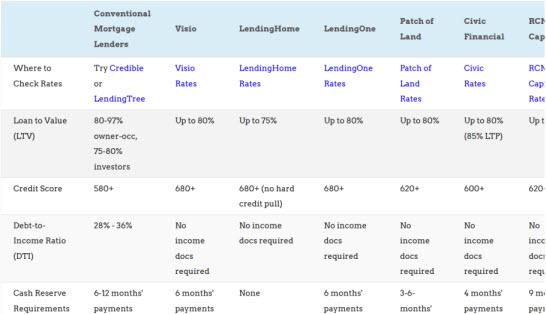 What short-term fix-and-flip loan options are available nowadays?
How about long-term rental property loans?
We compare several buy-and-rehab lenders and several long-term landlord loans on LTV, interest rates, closing costs, income requirements and more.
What This Actually Means for You
If you’re sitting on capital and wondering whether real estate makes sense, the answer depends on whether you’re willing to operate like an institution or like retail.
Retail treats real estate as a way to get rich quick. Institutions treat it as a way to generate durable, tax-advantaged cash flow with acceptable risk. Retail chases projected IRRs. Institutions stress-test assumptions and plan for downside.
The gap isn’t access. It’s patience.
You don’t need $50 million to invest like an institution. You need a checklist you refuse to skip, a diversification plan that limits single-deal risk, and the discipline to walk away from deals that don’t pass the smell test. That framework works at $5,000. It works at $500,000. The capital scales. The process doesn’t change.
Real estate can beat the S&P 500. But only if you stop investing like the retail investors Dalbar studied and start vetting deals like the institutions that actually generate the returns everyone else is chasing.
The choice isn’t between stocks and real estate. It’s between operating with discipline or operating on hope. Hope underperforms in every asset class.
About the Author

G. Brian Davis is a real estate investor and cofounder of SparkRental who spends 10 months of the year in South America. His mission: to help 5,000 people reach financial independence with passive income from real estate. If you want to be one of them, join Brian and Deni for a free class on How to Earn 15-25% on Fractional Real Estate Investments.
Connect with us on social!