The Short Version:
-
- Most investors calculate cash flow as “rent minus mortgage” — this ignores 50% of actual expenses (vacancy, repairs, CapEx, property management, maintenance)
- The 50% Rule: expect ~50% of rent to go toward non-mortgage expenses over time — not every month, but averaged over years of ownership
- Typical month ≠ long-term average — roofs, HVAC, appliances, tenant turnover don’t happen monthly but cost thousands when they do
- Brian bought 12 rental properties using flawed math before learning this (lost money on “cash-flowing” properties that weren’t actually profitable)

I bought my first rental property thinking I understood cash flow.
The rent was $1,200 a month. The mortgage payment was $850. That left me with $350 in monthly cash flow, which seemed pretty good for a property I bought with only $15,000 down.
Except it wasn’t $350. Not even close.
By the time I accounted for actual expenses… not the expenses I hoped for, but the ones that actually showed up… I was barely breaking even. Some months I was losing money.
And I didn’t just make this mistake once. I made it twelve times. Twelve properties, all purchased with the same flawed understanding of how cash flow actually works.
Here’s the embarrassing truth: I was in the real estate industry when I made these mistakes.
I was working for a hard money lending company, financing fix-and-flip deals for experienced investors. I was surrounded by people who actually knew what they were doing. And somehow, I still managed to buy properties without understanding basic cash flow math.
The problem was hubris. I thought I could figure everything out on my own without needing a mentor or bothering to learn from people who’d already made the mistakes.
The universe corrected that thinking in 2008 when the market crashed and all twelve of my “cash-flowing” properties suddenly weren’t.
Looking back, the crash didn’t create my problem. It just exposed it. I had been losing money the whole time. I just didn’t realize it yet because I was confusing a typical month with the long-term average.
The Fatal Mistake: Rent Minus Mortgage
When most people analyze a rental property, they do this calculation:
Monthly rent – Monthly mortgage payment = Cash flow
It’s simple. It’s clean. And it’s completely wrong.
That’s exactly what I was doing. I’d look at a property, see that the rent covered the mortgage with a few hundred dollars left over, and think I had a winner.
The problem is that the mortgage payment isn’t your only expense.
Real estate has dozens of expense categories that don’t show up in a typical month but average out to significant costs over time. Property taxes. Insurance. Vacancy between tenants. Repairs. Maintenance. Property management fees. Capital expenditures like roof replacements. HOA fees.
When you’re analyzing a property in January and it has a good tenant who’s been there for two years, none of those costs are visible. The only expenses you see are the mortgage, property tax, and insurance.
So you think: rent minus those few expenses equals great cash flow.
But that’s not the long-term reality. That’s just what this specific month looks like.
The 50% Rule (The Number I Wish I’d Known Earlier)
There’s a rule of thumb in real estate investing called the 50% Rule.
It says that over time, you should expect roughly 50% of your rental income to go toward non-mortgage expenses.
Not every month. Not even most months. But averaged over the years you own the property, about half the rent will disappear into operating expenses before you ever get to the mortgage payment.
When I first heard this rule, my immediate reaction was: “That’s impossible. There’s no way my expenses are that high.”
And that’s exactly the reaction most new investors have. Because when you look at any individual month, expenses don’t look like 50% of rent.
But a typical month is not representative of the long-term average.
Let me break down a real example.
Say you own a property that rents for $1,500 a month. Over the course of a year, here’s what expenses might actually look like:
- Property taxes: $200/month
- Insurance: $100/month
- Vacancy: One month empty averaged over 12 months = $125/month
- Repairs: $1,200/year averaged = $100/month
- Maintenance: $600/year averaged = $50/month
- Property management: 10% of collected rent = $150/month
- Capital expenditures (roof, HVAC, appliances): $3,000/year averaged = $250/month
Add those up: $975/month in non-mortgage expenses.
That’s 65% of the rent… before the mortgage payment.
And that’s assuming nothing major goes wrong.
Why New Investors Get This Wrong Every Single Time
There’s a psychological trap that catches almost everyone.
When you’re analyzing a property, you naturally anchor to what you can see right now. The current tenant is paying rent. The property looks fine. Nothing major needs repair.
So you project that current state forward and assume it will continue indefinitely.
But real estate operates on cycles. Tenants move out every 2-4 years. Appliances break every 10-15 years. Roofs need replacement every 20-25 years. HVAC systems fail every 15-20 years.
None of these happen in a typical month. But they all happen eventually. And when they do, they cost thousands of dollars.
If you’re not setting aside money every month for these inevitable expenses, you’re not actually cash-flowing. You’re just postponing losses until the next major repair hits.
I learned this lesson expensively. I’d have a property that seemed profitable for 18 months, and then the water heater would die ($1,200), the tenant would move out (one month vacancy + $800 in turnover costs), and suddenly that “profitable” property had cost me $2,000 in a single quarter.
(article continues below)
Real estate investments? Awesome.
Being a landlord? Less fun.
Learn how to earn 15%+ on passive real estate investments in our free video course.

What the 50% Rule Actually Tells You
Once you understand the 50% Rule, property analysis becomes brutally simple.
Take the monthly rent. Cut it in half. That’s roughly what you have available to cover the mortgage payment and still cash flow.
So if a property rents for $1,500/month, you’ve got $750 left after operating expenses. If your mortgage payment is $900, that property doesn’t cash flow. It loses $150/month on average.
If your mortgage payment is $600, you’ve got $150/month in actual cash flow.
This is why finding properties that genuinely cash flow is so difficult. You can’t just buy anything listed on the MLS and expect it to work.
You need to either find properties at below-market prices, put down larger down payments to reduce the mortgage, buy in markets where rent-to-price ratios are unusually favorable, or add value through renovations that increase rent significantly.
None of those are easy. All of them require work.
The Underlying Principle
Here’s what I eventually figured out: The market doesn’t care about your analysis.
You can convince yourself that a property will cash flow. You can run the numbers optimistically, assume low vacancy, assume minimal repairs, and make it work on paper.
But reality doesn’t negotiate. The roof will eventually need replacement whether you budgeted for it or not. The tenant will eventually move out whether you planned for vacancy or not.
The 50% Rule isn’t a perfect predictor for every single property. Some will run higher. Some will run lower, especially if they’re newer or in HOA communities where exterior maintenance is covered.
But as a screening tool, it’s incredibly valuable. It forces you to be honest about long-term costs instead of optimistic about short-term appearances.
And it separates people who actually know how to analyze real estate from people who think they know because they can subtract mortgage payments from rent.
(article continues below)
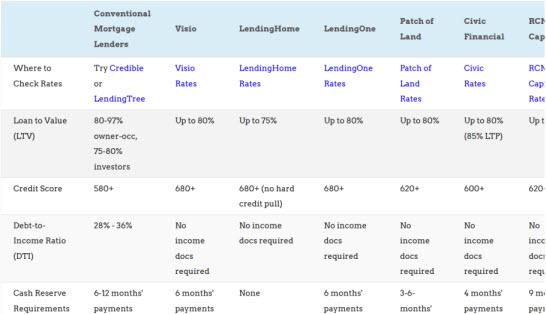 What short-term fix-and-flip loan options are available nowadays?
How about long-term rental property loans?
We compare several buy-and-rehab lenders and several long-term landlord loans on LTV, interest rates, closing costs, income requirements and more.
So what does this mean for you?
I can’t get back the money I lost learning this lesson. But I can help you avoid making the same mistake.
Before you buy your first rental property, run the 50% Rule calculation. Take the monthly rent, cut it in half, and see what’s left after the mortgage payment.
If the answer is negative or barely positive, walk away. You’re looking at a time bomb that will go off the first time something major breaks.
Once you understand this rule, you stop wasting time analyzing properties that were never going to work. You focus your energy on finding the deals that actually pencil out.
And if finding those deals sounds like more work than you want to take on, that’s understandable. Active rental property investing is hard. It requires knowledge, time, and the ability to spot opportunities that most people miss.
That’s exactly why passive real estate investing exists. Instead of buying properties yourself and hoping your math is right, you invest alongside experienced operators who’ve already made these mistakes and built systems to avoid them.
In the Co-Investing Club, we vet passive real estate investments where the operators have track records, the numbers are transparent, and the cash flow projections are based on real operating history instead of optimistic assumptions.
About the Author

G. Brian Davis is a real estate investor and cofounder of SparkRental who spends 10 months of the year in South America. His mission: to help 5,000 people reach financial independence with passive income from real estate. If you want to be one of them, join Brian and Deni for a free class on How to Earn 15-25% on Fractional Real Estate Investments.
Connect with us on social!