The Short Version:
-
- Most investors ask the wrong question before wiring funds… and that single mental error is why so many passive real estate deals quietly underperform
- Five risk categories sit underneath every syndication deal, and weak ones always fail somewhere visible if you know where to look
- The debt structure on a deal silently dictates the outcome more than the projected returns ever will… and one specific clause is currently sinking deals across the country
- A sponsor who only sends good news is waving a yellow flag. Here’s what trustworthy operators do differently when things go sideways

Most new investors walk into a passive real estate deal asking one question: how much can I make?
That’s the wrong starting point.
After two decades in this industry… and some expensive lessons along the way… the question I lead with now is different. How much could I lose? And under what circumstances would that happen?
That shift changes everything about which deals pass the test. It’s also what separates investors who build durable portfolios from those who chase yield and eventually get burned.
There are five categories of risk in almost every passive real estate deal. Walk a deal through all five, and the weak ones fail somewhere visible. Here’s how to use them.
Sponsor Risk
This one comes first because it matters most.
A strong operator can rescue a struggling deal. A poor one can destroy a perfectly sound investment. The asset, the market, the business plan… none of it matters much if the person executing it lacks experience, integrity, or alignment with your interests.
When we evaluate a sponsor, we’re looking at a few things. Track record across full market cycles, not just during the easy years. How they’ve handled deals that went sideways, because every operator eventually faces one. Whether they invest their own capital in the deals they bring to investors. And how they communicate when things aren’t going according to plan.
That last one matters more than most people realize. A sponsor who only sends good news is a yellow flag. A sponsor who proactively calls you when a market has softened, tells you what they’re doing about it, and gives you a clear-eyed picture of where things stand… that’s someone worth trusting with your capital.
We find sponsors primarily through referrals from other operators we already trust. When we meet with a sponsor, one of the last questions we ask is who else in this space they know and respect. People with integrity tend to know each other.
Debt Risk
The debt structure on a deal quietly determines a lot of the outcome. And in the current environment, it’s one of the first things we scrutinize.
Short-term bridge loans… the kind that mature in two or three years… require a refinance or sale at exactly the moment the market may not cooperate. We’ve passed on deals where the exit strategy was essentially “hope rates come down by 2026.” That’s not underwriting. That’s guessing.
What we prefer: longer-term fixed-rate debt, or deals where the sponsor has assumed an existing loan at a rate that pencils even today. We looked at one deal earlier this year where the operator had assumed a fixed loan at 5.1% with nine years remaining. Whatever happens in the next two years, they’re not forced to refinance into a tough market. Over a nine-year horizon, there will almost certainly be a good window to exit. That’s the kind of structure that lets a deal breathe.
Interest rate caps, loan covenants, prepayment penalties… these details matter. If a sponsor can’t walk you through their debt structure clearly and simply, that’s worth noting.
Construction Risk
Value-add deals involve renovation. Renovation involves contractors, timelines, and budgets that rarely survive contact with reality without a competent team managing them.
The question isn’t just whether the business plan makes sense on paper. It’s who’s actually doing the work, and how many times they’ve done it before.
We want to know if construction is handled in-house or outsourced. In either case, how many deals has this team completed together? First-time in-house construction is a different risk profile than a team that has done it twenty times. Sponsors who can show you a track record of renovations coming in on budget and on schedule are worth paying attention to. Sponsors who hand-wave the construction timeline are worth pressing harder.
Budget contingency is another signal. Operators who build meaningful contingency reserves into their projections are telling you they’ve been through renovations before. Operators who project everything going perfectly are telling you something else.
Property Management Risk
This one tends to be underrated.
Even a great asset in a good market can underperform with poor property management. Occupancy rates, tenant quality, maintenance response times, turnover costs… these are all management variables, not market variables. The operator controls them, or fails to.
We want to know who is managing the property. Whether it’s in-house or third-party. How many doors they currently manage in this specific market. And whether the sponsor has a track record with this particular management company or team.
A sponsor trying a new management firm for the first time on your deal is a different risk than one who has completed six projects with the same team. The relationship matters. The familiarity with a local market matters. We’ve seen deals get hurt not by the asset or the macro environment, but simply by a property management team that wasn’t equipped for that specific submarket.
(article continues below)
Real estate investments? Awesome.
Being a landlord? Less fun.
Learn how to earn 15%+ on passive real estate investments in our free video course.

Market Risk
Markets are not monoliths. A deal in Cleveland workforce housing carries different dynamics than a deal in a sunbelt market that built too many units in 2022 and 2023.
We look at supply and demand at the local level. Not just the headline metro numbers, but the specific submarket: what’s the rental vacancy rate, is new supply coming online in the next eighteen months, what does the median income look like relative to the rent being charged, and is the employment base stable or concentrated in a single industry.
Workforce housing in middle America has been one of the more durable plays in recent years. The demand is structural. Affordability has pushed a generation of renters out of homeownership indefinitely, and those renters still need somewhere to live. A well-located apartment complex serving that demand, with conservative underwriting, holds up across a lot of different economic scenarios.
Sunbelt oversupply is the opposite story in some cities. Markets that attracted massive development pipelines now face occupancy headwinds. The asset might be fine. The submarket might be working against you for several years.
The Underlying Principle
These five categories aren’t a checklist you run through once and file away. They interact with each other, and sometimes a deal that passes four of them fails hard on one.
The most important shift is this: great passive investing is primarily about risk management, not return optimization. A deal that advertises 18% projected returns with a two-year bridge loan, a first-time operator, and an untested management team isn’t a high-return opportunity. It’s a high-risk one wearing high-return clothing.
What we’re looking for is deals where the downside is bounded. Where even if things go sideways, the structure protects investors. Conservative debt gives time for markets to recover. Experienced operators know how to navigate difficulty. Established management teams hold occupancy through soft patches.
The upside takes care of itself when the downside is handled properly.
(article continues below)
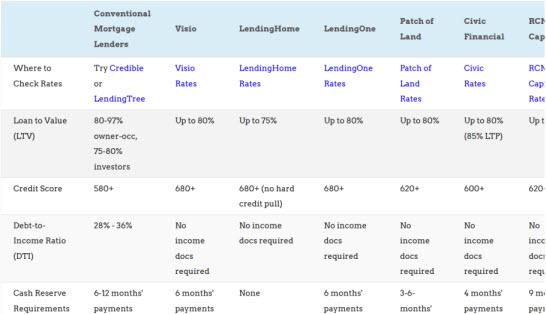 What short-term fix-and-flip loan options are available nowadays?
How about long-term rental property loans?
We compare several buy-and-rehab lenders and several long-term landlord loans on LTV, interest rates, closing costs, income requirements and more.
Conclusion
Every deal we review in the Co-Investing Club goes through all five of these lenses before anyone commits a dollar. Not every deal passes. Some fail on sponsor integrity. Some fail on debt structure. Some look great on paper until you look at the local supply pipeline and realize the occupancy assumptions don’t hold.
That’s the point of the framework. Bad deals should fail it. Good ones should be able to answer every question clearly.
If you’re evaluating passive real estate opportunities on your own, start here. Get comfortable asking hard questions about each of these categories before you wire a dollar. Most sponsors who have done this well will welcome the questions. The ones who get defensive are telling you something important.
About the Author

G. Brian Davis is a real estate investor and cofounder of SparkRental who spends 10 months of the year in South America. His mission: to help 5,000 people reach financial independence with passive income from real estate. If you want to be one of them, join Brian and Deni for a free class on How to Earn 15-25% on Fractional Real Estate Investments.
Connect with us on social!