The Short Version:
-
- A secured note investor can still get paid even if the deal itself falls apart… because their return isn’t tied to appreciation, rent growth, or a successful exit.
- In a foreclosure scenario, “first position” determines who gets paid first… and who’s left hoping there’s money remaining after the dust settles.
A note backed at 60% LTV can absorb massive property value declines before investor principal is even at risk. Most people never realize how much that buffer matters. - The investors earning the steadiest returns in real estate often aren’t the ones chasing upside… they’re the ones quietly collecting fixed payments backed by hard collateral every quarter.

No appreciation story, no value-add narrative, not even cocktail-party bragging rights.
A secured note doesn’t promise to 3x your money. It promises to pay you. On a schedule. At a fixed rate. Backed by a lien on a real piece of property.
For investors who have been chasing yield in a market where promises are easy and delivery is hard, that might actually be the most attractive thing they’ve heard in a while.
Here’s what secured notes are, how they work, and why they belong in more passive real estate portfolios than they currently occupy.
What a Secured Note Actually Is
When a real estate operator needs to borrow money… to acquire a property, fund renovations, or bridge to longer-term financing… they have options. Banks are one. Private lenders are another.
A secured note is a loan you make to a real estate operator or investor, backed by a lien on real property. You’re the lender. They’re the borrower. They pay you a fixed interest rate on a set schedule, and your loan is secured by an interest in whatever property they’ve pledged as collateral.
The key word is secured. Your investment isn’t backed by a promise or a handshake or a business plan. It’s backed by a legal interest in a physical asset. If the borrower defaults, you have a path to recovery through foreclosure on that property.
That’s meaningfully different from unsecured lending, and it’s meaningfully different from equity investing where your returns depend on a property performing according to plan.
First Position vs. Second Position
Not all notes carry the same risk. The most important variable is where your lien sits in the capital stack.
A first-position note means you’re first in line if something goes wrong. If the borrower defaults and the property gets foreclosed, you get paid before anyone else. Equity investors, other lenders, everyone. First position is the safest place to be in a secured lending scenario.
A second-position note means there’s another lender ahead of you. If the property sells in foreclosure, the first-position lender gets made whole first. You get whatever is left. In a scenario where the property has lost significant value, second-position lenders can end up with less than they’re owed, sometimes much less.
When we evaluate notes in the club, we strongly prefer first-position liens. The yield is typically lower than what second-position notes offer, but the protection is substantially better. In our view, chasing an extra two or three percentage points by taking a subordinate position is rarely worth the additional risk.
Loan-to-Value: The Number That Matters Most
The second critical variable is loan-to-value ratio, or LTV. This is the loan amount expressed as a percentage of the property’s value.
A note at 60% LTV means you’ve lent $600,000 against a property worth $1 million. If the borrower defaults and the property has to be sold quickly… even at a discount… there’s a meaningful buffer before you start losing principal. The property would have to lose more than 40% of its value for you to be underwater, and that’s before you’ve even started a foreclosure process.
A note at 85% LTV is a different story. The margin for error is thin. Property values don’t have to fall much before you’re at risk.
We generally look for notes in the 60-70% LTV range for first-position loans. It’s not the highest-yielding segment of the note market, but it’s the one where you can genuinely sleep at night knowing the collateral covers your exposure.
What Happens When a Borrower Defaults
It’s worth being clear-eyed about this, because some investors treat the foreclosure path as a theoretical comfort and never think about it practically.
If a borrower stops paying on a secured note, you don’t just lose your money and move on. You have legal remedies. As a lienholder, you can initiate foreclosure proceedings against the property. The specifics vary by state and loan structure, but the general mechanism is: you take the property, sell it, and recover your principal from the proceeds.
This process takes time. It involves legal fees. It’s not painless. But it is a real protection that unsecured creditors and equity investors don’t have.
The practical implication: your due diligence on the collateral matters. You want to understand what the property is worth independently of what the borrower says it’s worth. A recent appraisal from a qualified third party is the baseline. You also want to understand the local real estate market well enough to know whether that value is stable, rising, or at risk.
What Secured Notes Pay
Yields on first-position secured notes have ranged considerably depending on the market environment, the borrower’s creditworthiness, the LTV, and the property type. In the current rate environment, well-structured first-position notes have been offering anywhere from 8% to 12% annually, sometimes more for shorter-duration bridge scenarios.
Those aren’t projections tied to a business plan working out. They’re contractual. The rate is set at origination. The payment schedule is fixed. You know what you’re getting before you wire a cent.
That predictability is what makes notes attractive as part of a broader passive real estate portfolio. Equity investments offer the potential for meaningful upside… appreciation, profit on sale… but those returns aren’t guaranteed and depend on a lot of variables going according to plan. Notes give you a fixed return that doesn’t fluctuate with the real estate market.
The downside is the flip side of that same coin. You don’t participate in appreciation. If the property doubles in value over five years, you still collect your fixed rate and nothing more. The upside belongs to the equity holders.
For investors who are primarily seeking income rather than appreciation… particularly those closer to or in retirement, or those building a cash flow base to live on… that trade-off is often a good one.
(article continues below)
Real estate investments? Awesome.
Being a landlord? Less fun.
Learn how to earn 15%+ on passive real estate investments in our free video course.

Where to Find Note Investments as a Retail Investor
Individual notes, particularly at lower minimum investments, aren’t easy to find through traditional channels. Most of the private lending market operates through relationships: operators who need capital reach out to investors they know or who have been referred to them.
Note funds are another option. These are funds run by experienced private lenders who originate and manage a portfolio of notes, then distribute the income to fund investors. The advantage is diversification across many loans rather than concentration in a single borrower. The trade-off is that you’re trusting the fund manager’s underwriting rather than evaluating individual loans yourself.
We’ve invested in several note-based opportunities through the club over the years. In every case, the key evaluation criteria were the same: sponsor experience and track record, position in the capital stack, LTV, property type, and the market the collateral sits in. Every one of those investments has paid as agreed.
That track record doesn’t guarantee future results. But it does reflect what happens when the underwriting discipline is applied consistently.
The Underlying Principle
There’s a broader point worth making here that goes beyond the mechanics of secured notes.
Investors are often drawn to complexity and narrative. A value-add apartment story with a compelling business plan and a charismatic operator feels exciting. A note that just… pays a fixed rate every quarter… feels boring by comparison.
But boring, in investing, is often good. Boring means predictable. Boring means the return doesn’t depend on rent growth assumptions, exit cap rate expansion, or construction timelines going to plan. Boring means you know what you signed up for before the money leaves your account.
In a market where too many investors have been surprised by deals that looked great on the pitch deck and underperformed in reality, there’s genuine value in an investment whose upside is capped but whose downside is protected by a legal claim on real property.
The best passive portfolios tend to combine both. Equity positions for growth and appreciation potential. Note investments for stable, predictable income. The balance depends on where you are in your investing life and what you actually need your money to do.
(article continues below)
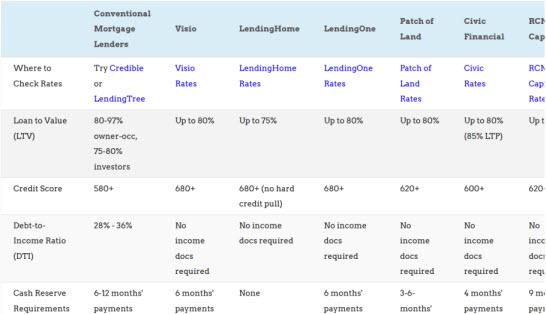 What short-term fix-and-flip loan options are available nowadays?
How about long-term rental property loans?
We compare several buy-and-rehab lenders and several long-term landlord loans on LTV, interest rates, closing costs, income requirements and more.
So what does this mean for you?
Secured notes won’t make you rich overnight. They’re not designed to. They’re designed to pay you reliably, protect your principal through collateral, and let you collect fixed income without depending on a business plan going according to schedule.
For investors building a passive income base… or looking to balance a portfolio that’s already heavy in equity real estate… they’re worth understanding.
The mechanics aren’t complicated once you know them. First position matters. LTV matters. Collateral quality matters. Operator track record matters. Apply those criteria consistently and you end up in deals that pay like clockwork, which, as it turns out, is exactly what most investors actually want.
About the Author

G. Brian Davis is a real estate investor and cofounder of SparkRental who spends 10 months of the year in South America. His mission: to help 5,000 people reach financial independence with passive income from real estate. If you want to be one of them, join Brian and Deni for a free class on How to Earn 15-25% on Fractional Real Estate Investments.
Connect with us on social!